AI Is Making Skilled Professionals Worse at Their Jobs. Operators Need to Know This.
Early research from The Lancet and Anthropic shows AI tools are quietly eroding the skills of experienced professionals. Here is what that means for any operator deploying AI inside a team.
The Signal #034 — Dakota’s read on the AI news that actually matters to people running a business.
The concern used to sound theoretical. Professionals lean on AI long enough, the thinking goes, and they stop being as sharp without it. Reasonable worry. Hard to prove.
Now there is actual data. And the numbers are not comfortable.
What happened
Nature published a piece this month pulling together early research on AI-driven deskilling, the idea that using AI tools causes human skill to atrophy. Two studies stand out.
The first, published in The Lancet Gastroenterology and Hepatology, looked at physicians in Poland who specialize in endoscopy. These were experienced doctors, each with at least 2,000 colonoscopies behind them. Researchers gave them access to an AI system that analyzed colonoscopy images in real time and flagged a type of precancerous lesion called an adenoma. The tool was available on some days but not others.
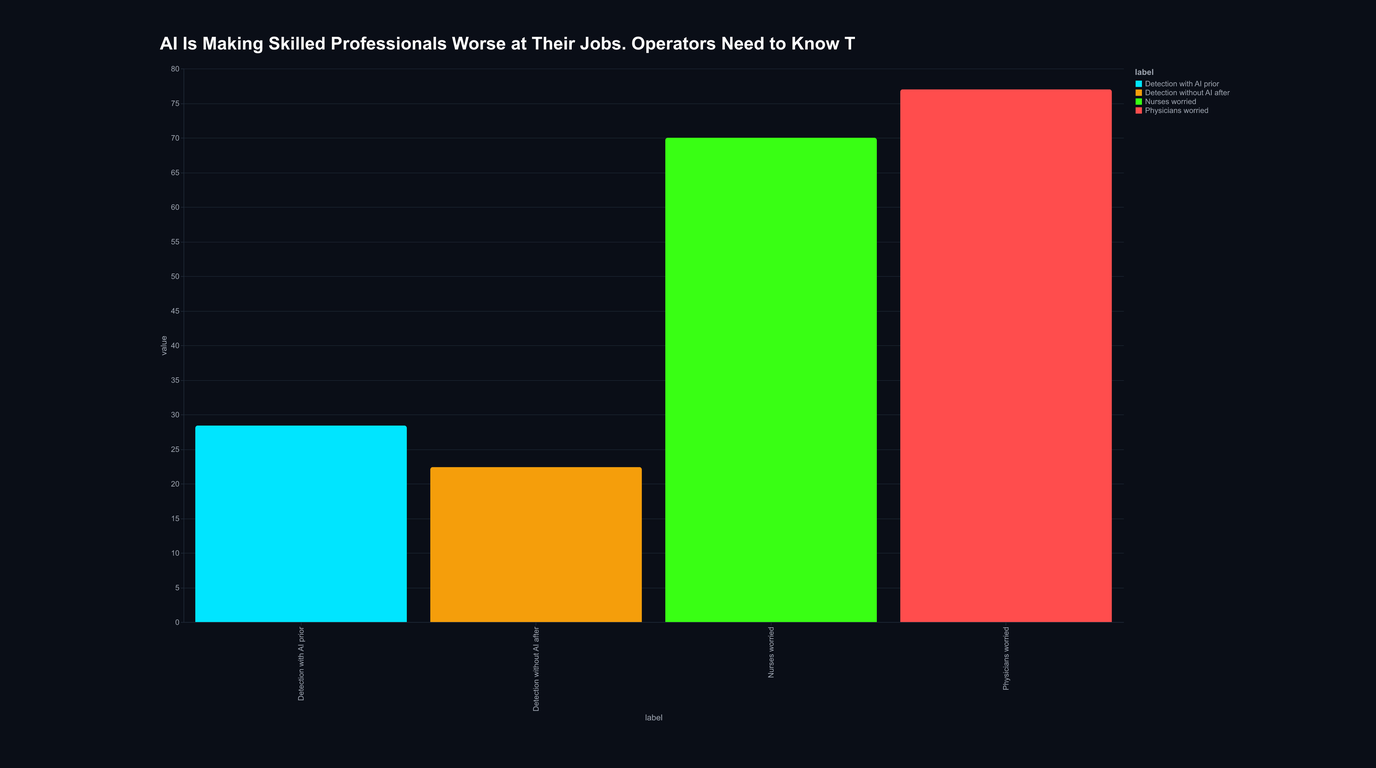
Before the AI tool was introduced, the physicians detected at least one adenoma during 28.4% of colonoscopies. After the tool was introduced, their detection rate on days without AI assistance dropped to 22.4%. Three months was enough to move the needle.
The study authors write that continuous exposure to these tools can cause clinicians to become “less motivated, less focused, and less responsible when making cognitive decisions without AI assistance.”
The second study comes from researchers at Anthropic, the AI company. They ran a randomized controlled trial with 52 software engineers performing a basic coding task. All 52 could search the web and access reference materials. Half were also given an AI assistant. The study is looking at whether the group using AI carried their performance forward or became dependent on the tool. The Nature article does not share the final numbers, but the framing is pointed: the researchers designed the experiment specifically to measure skill loss.
Kevin Crowston, an information scientist at Syracuse University, put it plainly in the article. “Just being aware that this phenomenon exists hopefully provokes some self-reflection about which skills people want to maintain and which they’re willing to outsource.”
Yuichi Mori, a physician-researcher at the University of Oslo and co-author of the colonoscopy study, added: “There is no established solution against deskilling right now. It should be a very hot research topic in the next decade.”
Separately, a survey of US health care workers published earlier this month found that 70% of nurses and 77% of physicians are worried about losing skills due to over-reliance on AI systems.
Why it matters for operators
This is not a medicine problem or a coding problem. It is a human cognition problem, and it applies to any role where AI is now sitting between a person and a decision.
Think about a financial analyst at an asset management firm who now has AI summarizing every earnings call. Or a paralegal at a law firm who uses AI to draft the first pass of every contract review. Or a buyer at a retail company who uses AI to generate purchasing recommendations. The work still gets done. The outputs might even look better in the short run.
But if the AI goes down, or produces something wrong, the human in the seat needs to catch it. That requires the underlying skill to still be there.
The colonoscopy study is a good proxy for this dynamic because the stakes are clear. A missed adenoma has consequences. In most business contexts the stakes are lower, but the mechanism is the same. A person who stops exercising a judgment muscle because a tool does it for them will be slower and less reliable when the tool is unavailable or wrong.
For an operator, this is a workflow design question, not just a training question. How much of a given task has AI taken over, and does your team still have the reps to operate without it?
What most people get wrong
Most operators evaluate AI tools by asking whether they make the team faster or cheaper. Those are real metrics. They are worth tracking.
What almost no one is measuring is the skill baseline. Is the team better or worse at the core judgment underneath the task? Most operators have no idea, because they never set a baseline before rolling out the tool.
The colonoscopy researchers could measure the drop precisely because they had a clear pre-AI detection rate to compare against. That kind of before-and-after comparison is almost never happening inside business operations. The tool goes in, output volume goes up, and everyone moves on.
That gap will matter later. Not for every task, some things are genuinely fine to outsource completely to a machine. But for the decisions that require trained human judgment when things go sideways, you need to know whether your people still have it.
The short version
AI tools can produce good outputs while quietly degrading the human capacity behind them. That is not an argument against using AI. It is an argument for being deliberate about which skills you are choosing to keep sharp and which you are choosing to hand off for good.
The distinction matters. Make it on purpose.
If you are thinking through how AI fits into your team’s workflow without creating blind spots, the work we do at xovionlabs.com is worth a look.