A Fully Open AI Model Built by Universities. Here's What Operators Should Take From It.
EPFL, ETH Zurich, and CSCS just released Apertus, a fully open foundation model built for sovereign AI. Here's what that architecture decision means for operators who care about compliance, data control, and vendor independence.
The Signal #033 — Dakota’s read on the AI news that actually matters to people running a business.
Most AI news follows a familiar pattern. A big lab ships something impressive, a press release goes out, and operators are left trying to figure out whether it applies to them. This one is different, and the reason it’s different is worth understanding.
What happened
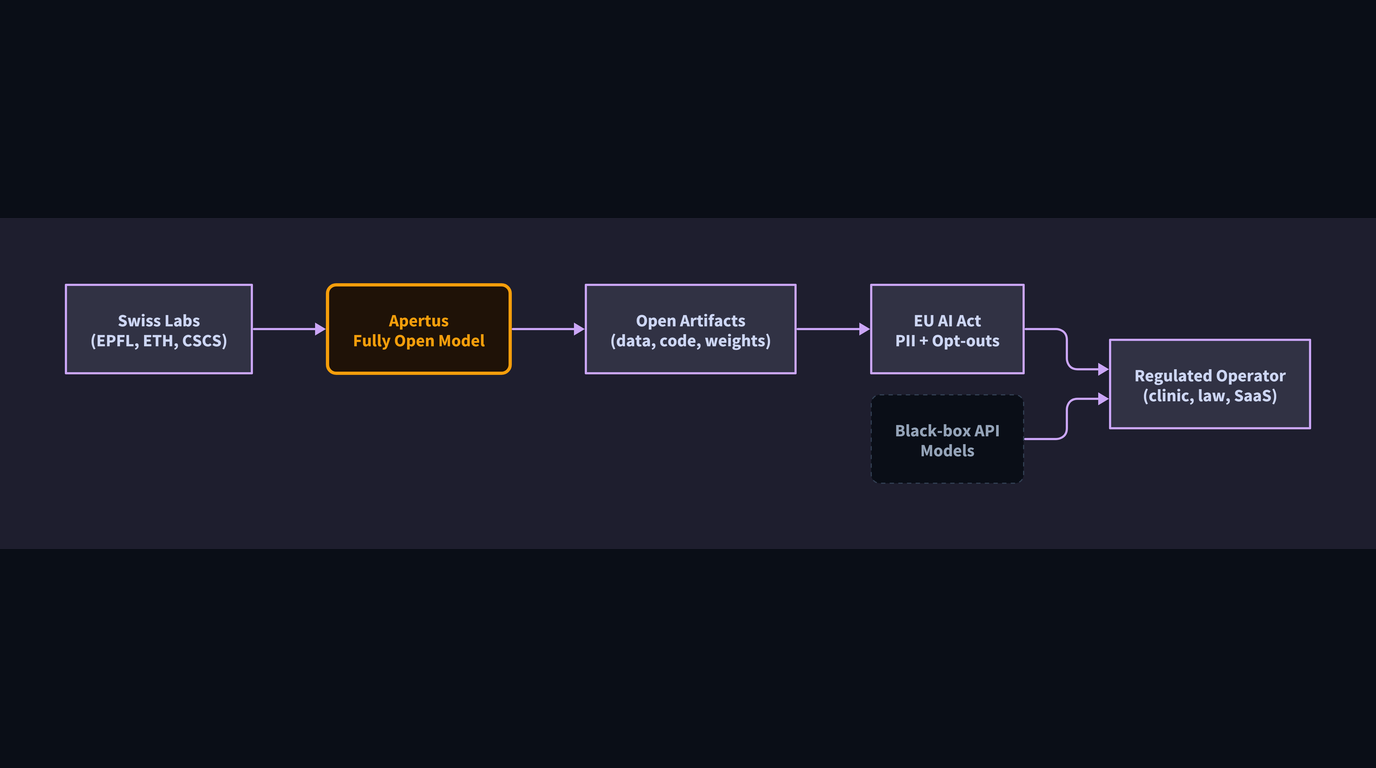
A consortium of Swiss research institutions, EPFL, ETH Zurich, and the Swiss National Supercomputing Centre (CSCS), released a foundation model (a large AI model trained on broad data that other systems can be built on top of) called Apertus. It was developed under the Swiss AI Initiative, with Swisscom as a strategic partner.
What makes Apertus notable is what they chose to release. Training data, code, weights (the internal numerical settings that define how the model behaves), methods, and alignment principles. All of it. Documented and reproducible. Their framing: “Apertus is to AI as Open is to Source.”
The model runs at 8B and 70B parameters (a rough measure of model size and capability, where more parameters generally means more capacity to handle complex tasks) and is described as competitive with top open models at equivalent scale. It was trained on over 1,000 languages from day one. In June 2025, they released Apertus Mini, a set of 16 small language models built to demonstrate distillation and quantization techniques (methods for making large models smaller and faster without losing too much capability). Their technical report was accepted at ACL 2026, a leading conference for AI and language research.
One more detail worth noting. Apertus was built to meet EU AI Act requirements. That means it respects opt-outs, removes personally identifiable information (PII), and is designed to prevent the model from memorizing and reproducing private data it was trained on.
Why it matters for operators
If your business operates in a regulated environment, handles sensitive customer data, or serves clients in the European Union, the compliance architecture here is the thing to pay attention to.
Most foundation models are black boxes. You use them through an API (an application programming interface, the technical bridge that lets your software talk to the AI provider’s system), and you take the provider’s word on how the model was trained, what data it saw, and whether it meets your legal obligations. That works fine until a regulator, a client, or your own legal team asks you to prove it.
Apertus is structured differently. Because everything is documented and reproducible, an operator building on top of it, say a clinic managing patient intake workflows, a law firm running document review, or a SaaS company serving EU customers, can actually inspect the training process. They can point to evidence that PII was removed. They can show that the model respects data opt-outs. That is a meaningfully different conversation to have with a compliance officer than “we use a reputable provider.”
The sovereign AI framing is also worth understanding. Sovereign AI refers to the idea that a country, institution, or organization should have real control over the AI systems it depends on, including the ability to run them independently, audit them, and modify them without relying on a single private vendor. Apertus is an example of what that looks like in practice, not as a concept, but as a shipped model with open weights you can actually run.
What most people get wrong
Operators often hear “open source AI” and translate it mentally to “free and good enough.” That framing misses the actual value.
The value of a fully open model is not the price. It is the auditability. When a model’s training data, weights, and methods are documented, you can answer questions that closed models cannot answer for you. Where did this data come from? Was my customers’ information in it? Can I reproduce this result? Can I run this model inside my own infrastructure without sending data to a third party?
For a manufacturing operation handling proprietary process data, or a healthcare organization subject to HIPAA, or an agency working under strict client confidentiality agreements, those questions are not academic. They are operational. The ability to answer them is the actual differentiator, not the benchmark scores.
The Apertus Mini release is also a signal worth tracking. Distillation and quantization techniques mean smaller, faster models that can run on less expensive hardware. That is the path toward AI that runs on your own servers, not just in a cloud provider’s data center.
The lesson
Not every AI deployment needs a fully open model. But every operator should understand what they are giving up when they choose a closed one. Apertus is a concrete example of what full transparency looks like, and it raises a reasonable question for anyone procuring AI right now. If you had to prove your model’s compliance to a regulator tomorrow, could you?
If you want to think through what AI architecture actually makes sense for your operation, xovionlabs.com is a good place to start.