Cloudflare Just Gave AI Agents a Way to Deploy Code Without a Human Account. Here's What Operators Should Notice.
Cloudflare launched temporary accounts that let AI agents deploy websites, APIs, and workers instantly without signing up. Here's what that friction-removal pattern means for operators building or buying AI systems.
The Signal #035 — Dakota’s read on the AI news that actually matters to people running a business.
There is a wall that stops most AI agents cold the moment they try to do something real. Not a technical wall. An account wall. A browser-based login screen, a copy-paste token step, a multi-factor authentication prompt that requires a human to tap a button. For a coding agent running in the background with no human watching, that is not an inconvenience. It is a hard stop.
Cloudflare just did something about that. And the pattern they used is worth understanding if you are an operator thinking about where AI automation breaks down in your own systems.
What happened
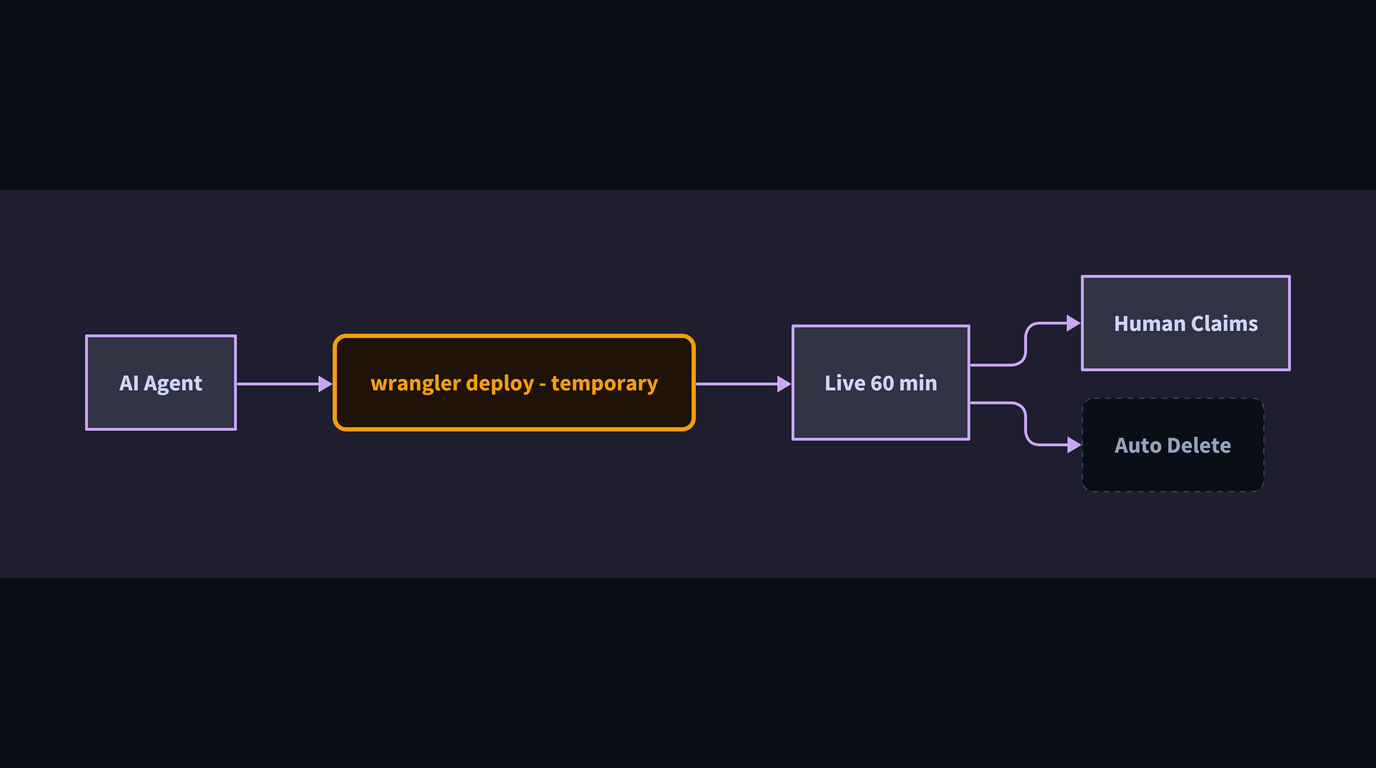
On June 19, 2026, Cloudflare announced Temporary Accounts for Agents. The short version: an AI agent can now run a single command, wrangler deploy --temporary, and instantly deploy a website, API, or worker to Cloudflare’s infrastructure. No account required upfront. No signup flow. No credentials to manage.
The deployment stays live for 60 minutes. During that window, a human can claim the temporary account and make it permanent. If no one claims it, it expires automatically and gets deleted. Cloudflare also provides a claim URL that the agent can hand back to the human, so the handoff is clean.
There is a small detail in the announcement worth noting. Cloudflare updated their Wrangler tool (a command-line interface that developers use to deploy code) to actively tell the agent about the --temporary flag when it tries to deploy without credentials. The agent does not need a human to explain the option. The tool surfaces it on its own.
Cloudflare also noted they recently announced a partnership with Stripe and a new protocol they co-designed together, letting agents provision Cloudflare accounts on behalf of users, including creating an account, starting a subscription, registering a domain, and getting an API token, with no copy-pasting tokens or entering credit card details.
Why it matters for operators
Most conversations about AI agents focus on what the agent does. The task it completes. The output it produces. What this Cloudflare announcement points at is something different: what happens when an agent hits a boundary it cannot cross on its own.
Every business has these boundaries. A SaaS company might have agents that help with code deployment but get stuck the moment they hit an auth (authentication, the process of verifying identity to gain access) checkpoint. A healthcare practice might have agents summarizing records that stall when they try to pull data from a connected system that requires manual login. An e-commerce operation might have agents that can draft purchase orders but cannot submit them because the supplier portal demands a human to log in first.
The specific Cloudflare solution is for software deployment. But the underlying design choice is broadly useful as a mental model. They did three things: they removed the requirement for an account before the agent could do useful work, they scoped the agent’s access with a time limit (60 minutes), and they built a clean handoff so a human can take ownership when they want to.
That scoped, time-limited, human-claimable model is a reasonable blueprint for how operators should think about any system where an agent needs temporary access to do a job. Give the agent enough access to complete the task. Set a boundary around how long that access lasts. Make it easy for a human to review and take over.
What most people get wrong
Operators evaluating AI automation tend to audit the intelligence of the agent. Can it understand the task? Does it produce good output? Those are fair questions. But the failure point that kills most real deployments is not intelligence. It is integration.
An agent that can reason well but cannot get through your authentication system is not functional. An agent that writes excellent outputs but cannot connect to the software where those outputs need to land is a demo, not a workflow. The boring infrastructure layer, accounts, tokens, permissions, time limits, is where agentic systems actually succeed or fail in production.
Cloudflare’s announcement describes the problem plainly. Background AI sessions have no human in the loop and are becoming the norm. Any step that needs a browser, a copy-paste, or a time-sensitive click means an agent gets stuck. That sentence is worth reading twice if you are in a conversation with a vendor about deploying agents inside your operation. Ask them specifically how the agent handles authentication steps. Ask what happens when it hits a system that was designed for a human to log into. The answer will tell you a lot.
The lesson
The smartest agents in the world are only as useful as the infrastructure around them allows. Cloudflare solved one version of this problem for software deployment. The broader pattern, scoped access, time limits, clean human handoffs, is something every operator building with AI should be thinking about for their own systems.
Friction in the account and access layer is not a footnote. It is often the whole problem.
If you are working through where AI automation is stalling in your operation, the team at xovionlabs.com thinks about exactly this kind of infrastructure question.