Voice AI Just Got a New Architecture. Here Is What Operators Should Actually Notice.
OpenAI launched GPT-Live on July 8, 2026, a full-duplex voice model that listens and speaks at the same time. Here is what that architectural shift means for anyone building or buying voice AI in their business.
The Signal #042 — Dakota’s read on the AI news that actually matters to people running a business.
Most voice AI announcements sound the same. Faster. Smarter. More natural. You read the headline, nod, and move on.
This one is worth a slower read. Not because of the product itself, but because of the architecture underneath it. The change OpenAI made explains why every voice AI experience you have used so far has felt slightly off, and what it would take to fix that.
What happened
On July 8, 2026, OpenAI released GPT-Live, a new generation of voice models now powering ChatGPT Voice. They launched two versions, GPT-Live-1 and GPT-Live-1 mini, and rolled them out to ChatGPT users globally. An API version is coming, with a sign-up form already open for developers and enterprises.
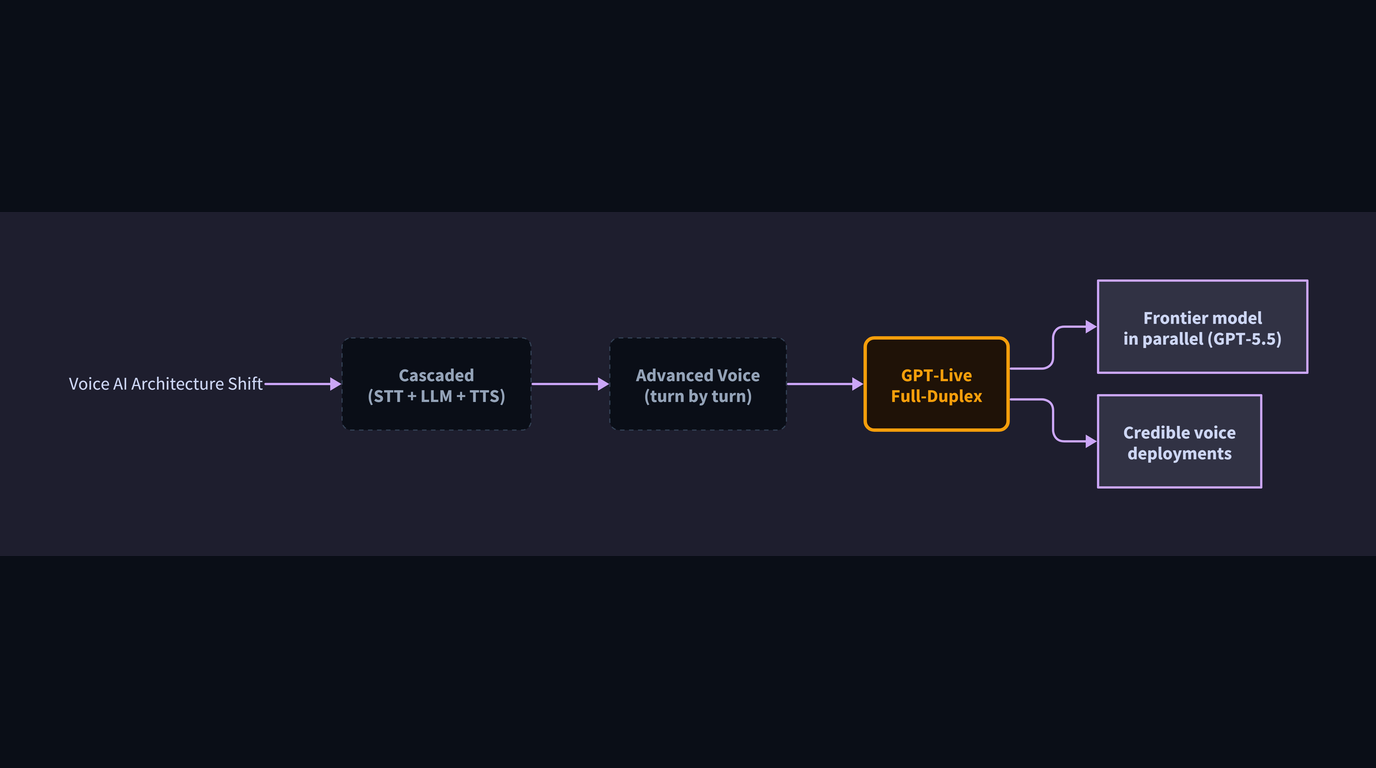
The headline capability is full-duplex architecture. Full-duplex means the model can listen and speak at the same time, the same way two people can talk in a real conversation without one person having to fully stop before the other begins. GPT-Live can respond with a quick acknowledgment like “mhmm” or “yeah” while still processing what you are saying. It can stay quiet when you need a moment to think. It does not misread a brief pause as the end of your sentence.
When a question requires web search, deeper reasoning, or more complex work, GPT-Live delegates to a frontier model running in the background, currently GPT-5.5, and keeps the conversation going while that work happens. The two systems run in parallel rather than in sequence.
OpenAI also noted that each week, more than 150 million people talk to ChatGPT using voice features.
Why it matters for operators
The practical gap between old voice AI and this architecture is not cosmetic. It is structural.
Older systems, including the original ChatGPT Voice, used what OpenAI calls a cascaded approach. Three separate models, each handing off to the next. Speech gets transcribed. Text goes to the language model. Response gets converted back to speech. Each handoff introduced delay and potential information loss. The result was the stilted, slightly robotic rhythm you have probably noticed in every voice AI product you have tested.
The previous step up, Advanced Voice Mode, moved processing into a single model, which reduced latency. But it still operated turn by turn. The model had to wait for you to finish speaking before it could respond. A pause, or background noise, could trigger a premature interruption.
For a business actually trying to deploy voice AI, these were not minor annoyances. They were the reason adoption stalled. A customer calling a SaaS company’s support line hangs up faster than they would with a human agent if the voice AI keeps interrupting them or takes three seconds to respond after every sentence. A patient calling a healthcare provider to reschedule an appointment does not want to navigate rigid turn-taking. A financial services firm building a client intake experience needs the voice interaction to feel credible, not mechanical.
GPT-Live’s internal evaluations tested it on realistic, multi-turn telecom support tasks, and GPT-Live-1 outperformed Advanced Voice Mode on that benchmark. That is a practical, operator-relevant test, not just an academic one.
The delegation architecture also matters. Voice handling and reasoning are now decoupled. The model that keeps the conversation flowing is not the same model doing the deep work. That separation means more complex tasks, like pulling account information, running a search, or reasoning through a multi-step problem, no longer require pausing the interaction. For anyone building voice workflows on top of AI, that is a meaningful design shift.
What most people get wrong
Most people evaluate voice AI by playing with it for five minutes and deciding whether it sounds good. That test misses the real question.
The right question is whether the architecture can handle the failure modes your actual users will create. Crosstalk. Interruptions. Background noise. Long pauses while someone looks something up. Sentences that trail off and restart. Real conversations are messy, and voice AI built on turn-based, silence-detecting logic breaks on that messiness in ways that frustrate users and erode trust quickly.
The other thing operators get wrong is treating voice AI as a phone channel feature only. GPT-Live’s full-duplex design is also described by OpenAI as groundwork for longer-running, more agentic work over voice. That points toward voice becoming a legitimate control surface for complex workflows, not just a way to answer frequently asked questions hands-free.
If you are scoping a voice AI project right now, the architecture your vendor is running on matters more than the demo sounds.
The lesson
A better voice experience is not just a product improvement. It is a signal that the underlying architecture has changed enough to make previously impractical deployments worth reconsidering.
Full-duplex, parallel processing, and decoupled reasoning are not buzzwords. They are the specific reasons the next generation of voice AI will behave differently from what you tested six months ago and wrote off.
If your team is evaluating where voice fits in your operations, or if you tried it before and it did not hold up, this is a reasonable moment to look again.
For more on how to think through AI decisions like this one, visit xovionlabs.com.