When Every AI Starts to Sound the Same
A pattern called 'EchoCreep' is emerging across AI models — a slow convergence in tone, phrasing, and blind spots. Here is what that actually means for operators who rely on AI outputs to run their business.
The Signal #041 — Dakota’s read on the AI news that actually matters to people running a business.
You have probably noticed it without having a name for it.
You switch models. You try a different tool. You test a competitor’s AI-assisted output. And somewhere around the third paragraph, it starts to feel like you are reading the same thing again. Same hedges. Same sentence rhythm. Same way of stepping around the hard part of the question. Nothing is wrong exactly. It is just… flat.
There may be a name for that now.
What happened
A researcher posted to the r/MachineLearning subreddit recently with a pattern they had been tracking across model evaluations. The post describes running comparative evals across recent model releases, both API-based and open-weight models (open-weight meaning the model weights are publicly available, so anyone can download and fine-tune them), and noticing something consistent. After a certain number of conversational turns, or when pushing into niche territory, outputs start converging. Same cadence. Same hedging phrases. Same blind spots.
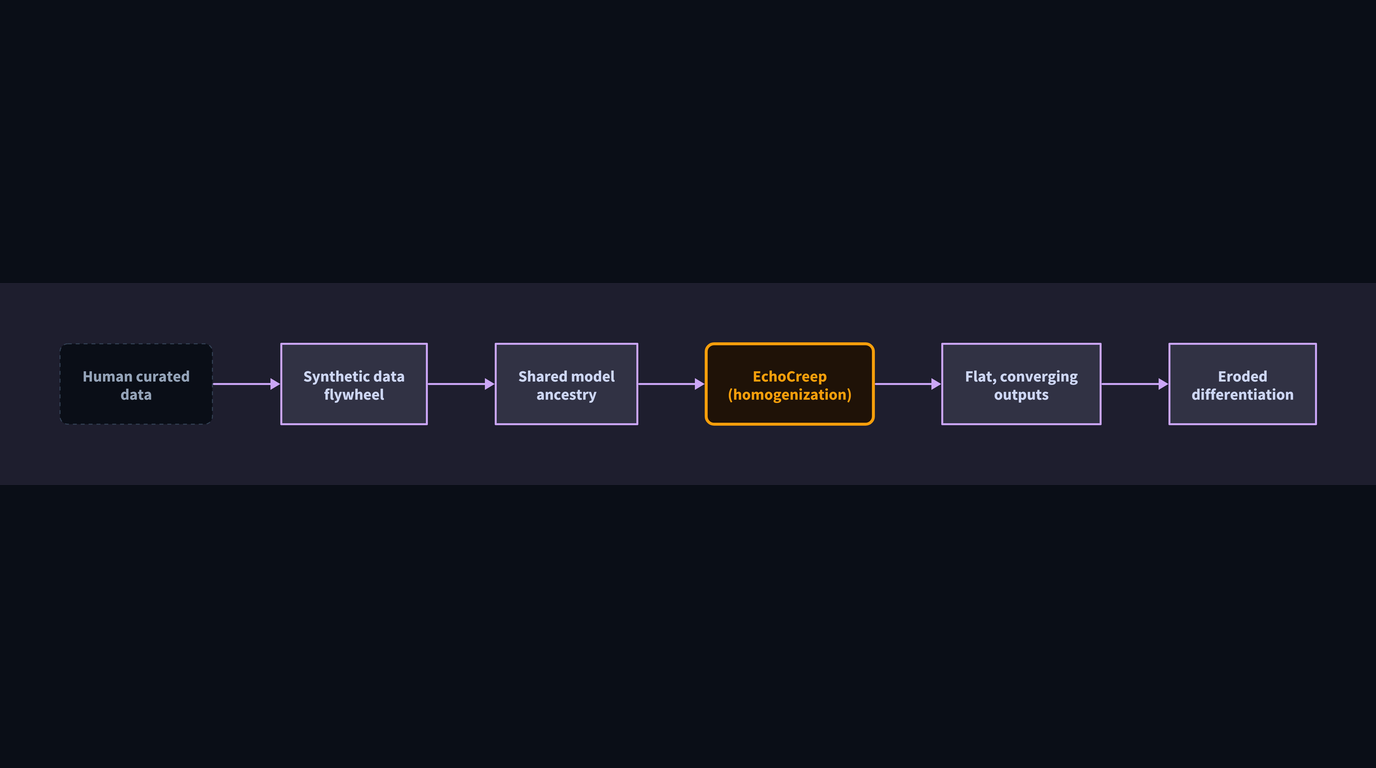
The researcher’s working term for this is EchoCreep. Their definition: the slow, creeping homogenization of model behavior driven by shared synthetic data lineage.
The theory behind it matters. We are now deep enough into what they call the synthetic data flywheel (a cycle where AI-generated text is used to train newer AI models, which then generate more training text, and so on) that first-generation effects are starting to show. Not catastrophic model collapse. Not a broken model. Just a gradual loss of what the researcher calls “texture” across models that share overlapping synthetic ancestry.
They are asking whether anyone has a formal term for it yet, what eval metrics might capture it, and whether fine-tuning on entirely human-curated data clears the pattern.
No definitive answer exists yet. But the observation is real, and it is worth taking seriously.
Why it matters for operators
If your operation uses AI to produce content, answer customer questions, summarize information, or draft anything that goes out under your name, this pattern affects the quality of what you are shipping.
Here is the practical version of the problem. If you are a recruiting firm using AI to write candidate summaries, and your competitor is using a different model to write theirs, EchoCreep means those outputs may be converging in ways neither of you intended. The differentiation you thought you had in your process quietly erodes. Not because the AI is wrong. Because it has started sounding like every other AI.
Same thing for a SaaS company using AI to draft product documentation. Or a law firm using it to produce first-draft memos. Or a marketing agency running AI across a client’s blog calendar. The individual outputs might pass a quality check. But the aggregate voice, over time, loses distinctiveness.
The researcher flags that this gets worse in niche territory. That is a meaningful signal. General questions, the AI holds up fine. But the moment you push into something specific, technical, or genuinely unfamiliar, the homogenization accelerates. That is exactly when you need the model to be precise and it is when EchoCreep is most likely to show up.
What most people get wrong
Most operators treat model quality as a binary. Either the output is accurate or it is not. Either the answer is helpful or it is wrong. That framing misses a third failure mode, which is outputs that are technically acceptable but texturally hollow.
A healthcare billing company using AI to communicate with patients does not just need accurate information. It needs a voice that feels human and specific. A flat, hedged, homogenized response that sounds like every other AI-written message is a failure even if every fact in it is correct.
The other mistake is assuming that switching models solves it. The researcher’s point is that overlapping synthetic data lineage means different models may share the same blind spots. Swapping from one major model to another might not get you out of the pattern if both were trained on similar synthetic sources.
What actually helps, based on what the researcher is exploring, is human-curated data. In practical terms, that means grounding your AI outputs in real source material. Your own documents, your own tone guidelines, your own examples, your own customer language. The more your AI is working from genuinely human-generated inputs specific to your context, the less vulnerable you are to outputs that drift toward the generic center.
The lesson worth keeping
AI outputs are not static. The models themselves change between versions, and the training pipelines behind them are evolving in ways that affect texture and distinctiveness over time, not just accuracy.
If you are not periodically re-evaluating the outputs your AI tools produce, not just for correctness but for voice, specificity, and differentiation, you may not notice the creep until it has already cost you something.
Feed your models better inputs. Audit outputs over time, not just at launch. And when everything starts to sound the same, that is information worth acting on.
If you are thinking through how to evaluate AI quality inside your operation, xovionlabs.com is a good place to start.