Your Notes App Is About to Get a Brain
OpenKnowledge is an open-source, AI-native markdown editor built to work directly with Claude, Codex, and other AI agents. Here is what that actually means for operators who store knowledge in docs, wikis, and shared folders.
The Signal #040 — Dakota’s read on the AI news that actually matters to people running a business.
Most teams have a knowledge problem dressed up as a software problem. The notes exist. The docs exist. The runbooks, the SOPs, the meeting summaries. They live somewhere in Notion or Obsidian or a shared Google Drive folder that nobody fully trusts anymore. The problem is not that the information is missing. It is that nobody can find it fast enough to use it, and no system has been able to close that gap without a full-time person managing it.
That assumption is starting to shift.
What happened
A project called OpenKnowledge surfaced on Hacker News this week. It is an open-source, local-first markdown editor built by the team at Inkeep, and it is explicitly designed to work with AI agents, not just human readers.
The repo has 890 stars and 27 forks as of this writing. It has shipped 182 releases. That pace matters. This is not a prototype sitting in maintenance mode.
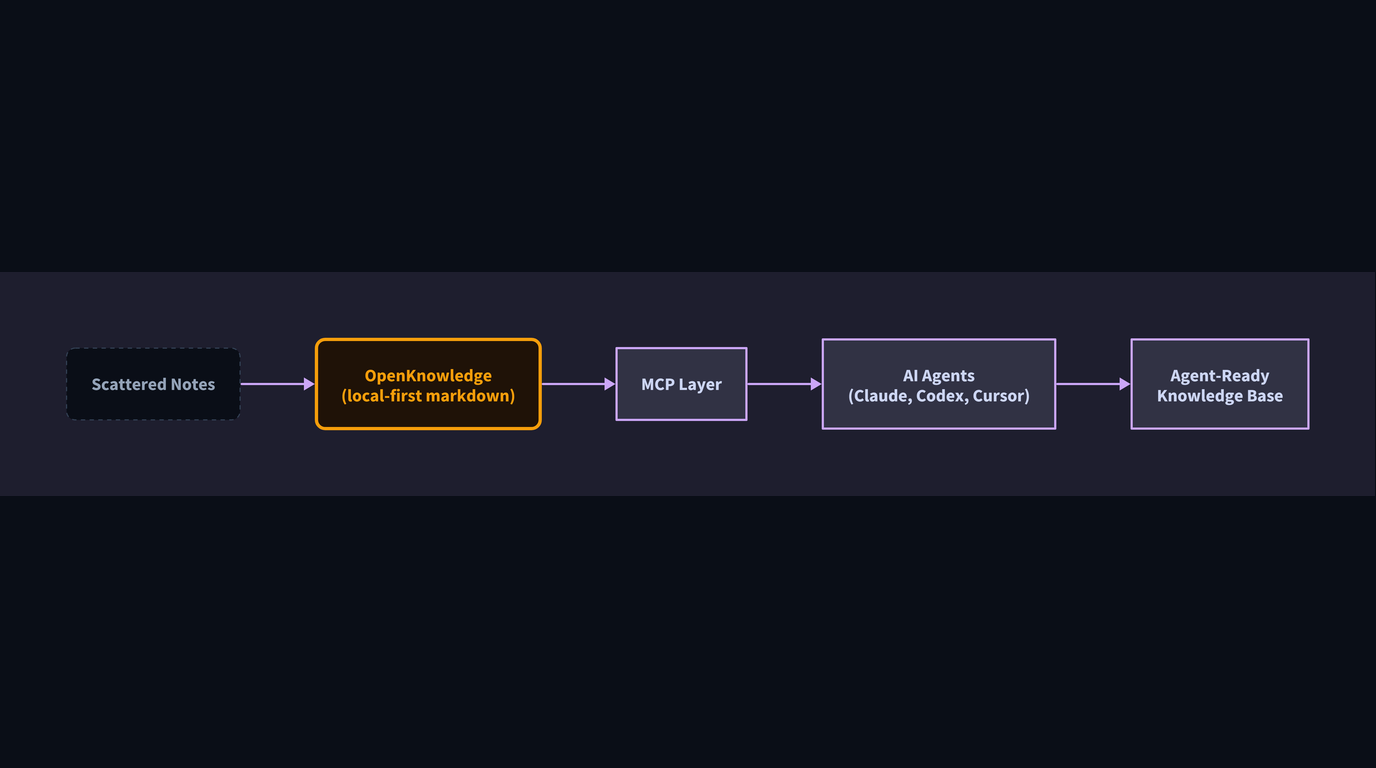
What makes it different from a standard notes tool is the architecture underneath. OpenKnowledge ships with out-of-the-box MCP (Model Context Protocol, a standard that lets AI agents read and write to external tools and data sources), direct integrations with Claude, Codex, and Cursor, and something the project calls agentic search for LLM wikis and agent second brains. It runs as a desktop app on macOS or as a local web app via CLI on Linux and Windows. It is WYSIWYG (what you see is what you get, meaning you edit it like a normal document instead of staring at raw code), so the markdown formatting happens invisibly.
The core pitch is this: your knowledge base should be something your AI agents can actually read, search, and write to, not just a place humans dump text.
Why it matters for operators
Most knowledge management tools were built for human readers. You open a doc, you read it, you close it. The assumption baked into their design is that a person is always in the loop.
AI agents do not work that way. An agent (a piece of AI software that can take a sequence of actions on its own, like researching, drafting, or updating records) needs to be able to pull context from somewhere when it is mid-task. If your knowledge lives in a system the agent cannot access or search properly, the agent either hallucinates (makes things up to fill the gap) or stalls and asks you to fill in what it needs manually.
This is the quiet bottleneck inside a lot of early AI deployments right now. Teams build an AI workflow, it works in demos, and then it falls apart in production because the agent keeps hitting a wall where the relevant context lives in a doc it cannot reach.
A tool like OpenKnowledge, built with MCP natively, means your wiki or internal knowledge base becomes something an agent can query in real time. A law firm running AI-assisted contract review can point the agent at its own precedent library. A SaaS support team can wire their troubleshooting runbooks directly into an AI that handles tier-one tickets. A manufacturing operation can make its maintenance procedures searchable by the same agent that monitors equipment status. The knowledge stops being a static archive and starts functioning as working memory for the AI doing the actual task.
What most people get wrong
The instinct when evaluating a tool like this is to think about whether it is a good notes app. That is the wrong question.
The question is whether your current knowledge infrastructure is readable by the AI you are building around. Most of it is not, not because the content is bad, but because nothing was ever built to expose it to an agent in a structured, searchable way.
Teams spend weeks prompt-engineering their AI assistants and almost no time thinking about what context those assistants can actually access. The output quality of any AI is bounded by the quality and accessibility of the information it can reach. Better prompts help at the margins. Better knowledge infrastructure helps structurally.
The open-source nature here also matters for operators who cannot send internal documentation through third-party cloud services. Local-first means the data stays where you put it.
The lesson
Your notes app is not just a place for humans to read anymore. If you are building any kind of AI workflow into your operation, the knowledge that workflow needs to access has to be structured for machine retrieval, not just human browsing. That is a design decision, and it is one most teams are not making yet.
OpenKnowledge is one early answer to that problem. There will be more. The operators who start thinking about knowledge infrastructure as AI infrastructure now will spend a lot less time patching gaps later.
If you want to think through what this means for your specific setup, xovionlabs.com is a good place to start.