Andrew Ng Just Compressed Agentic AI Into One Free Hour. Here Is What Operators Should Actually Take From It.
Andrew Ng released a free one-hour course covering AI agent basics, agentic workflows, multi-agent systems, and self-improving loops. Here is what the curriculum actually signals for operators making decisions about AI right now.
The operator's map of agentic AI
Click through the five levels. The useful distinction is not how impressive the vocabulary sounds — it is how much autonomy the system actually has.
AI assistant
Responds to a prompt, summarizes information, generates ideas, or drafts work. The human still initiates and directs nearly every step.
The bottleneck is thinking, drafting, searching, or interpreting — not moving work between systems.
“Does this need autonomy at all, or would a good copilot solve the problem?”
More agents ≠ better AI
The Signal #083 — Dakota’s read on the AI news that actually matters to people running a business.
A post went viral on X this week. Not because of a product launch or a funding round. Because of a free course.
Andrew Ng, one of the most cited names in applied machine learning, published a one-hour course covering how to understand and build AI agents from scratch. A summary thread by Dipanshu Kushwaha pulled 33,400 views, 709 reposts, and 406 likes in under 24 hours. The comments split immediately: some said Ng is essential, others said he is outdated. One reply clarified, correctly, that Geoffrey Hinton holds the more technical claim to the “Godfather of AI” title.
The debate over titles is a distraction. The curriculum is the story.
What happened
The course Ng published covers five distinct areas, timestamped in the thread: AI agent basics at the start, agentic workflows and design patterns at 12:12, practical tips for building agents at 53:27, self-improving AI agent loops at 1:20:30, and multi-agent AI systems at 1:30:19. One hour total. Free.
You can find the original thread at Dipanshu Kushwaha’s post on X.
The reaction from the person who shared it was blunt: halfway through, they felt they could realistically pursue a role at a company like Anthropic in weeks rather than years. That is a strong claim. It is also not the point for most people reading this.
Why it matters for operators
Most operators are not trying to get hired at an AI lab. They are trying to figure out what an agent (a piece of software that can take a sequence of actions on its own, like drafting, searching, updating records, or making decisions, without a human approving each step) actually means for their business and whether they need one.
The fact that a serious curriculum on this topic now fits inside one free hour tells you something important. The foundational concepts are not as esoteric as the job postings and consulting decks make them sound. Agentic workflows, design patterns, multi-agent coordination, self-improving loops: these are learnable ideas. They are not magic.
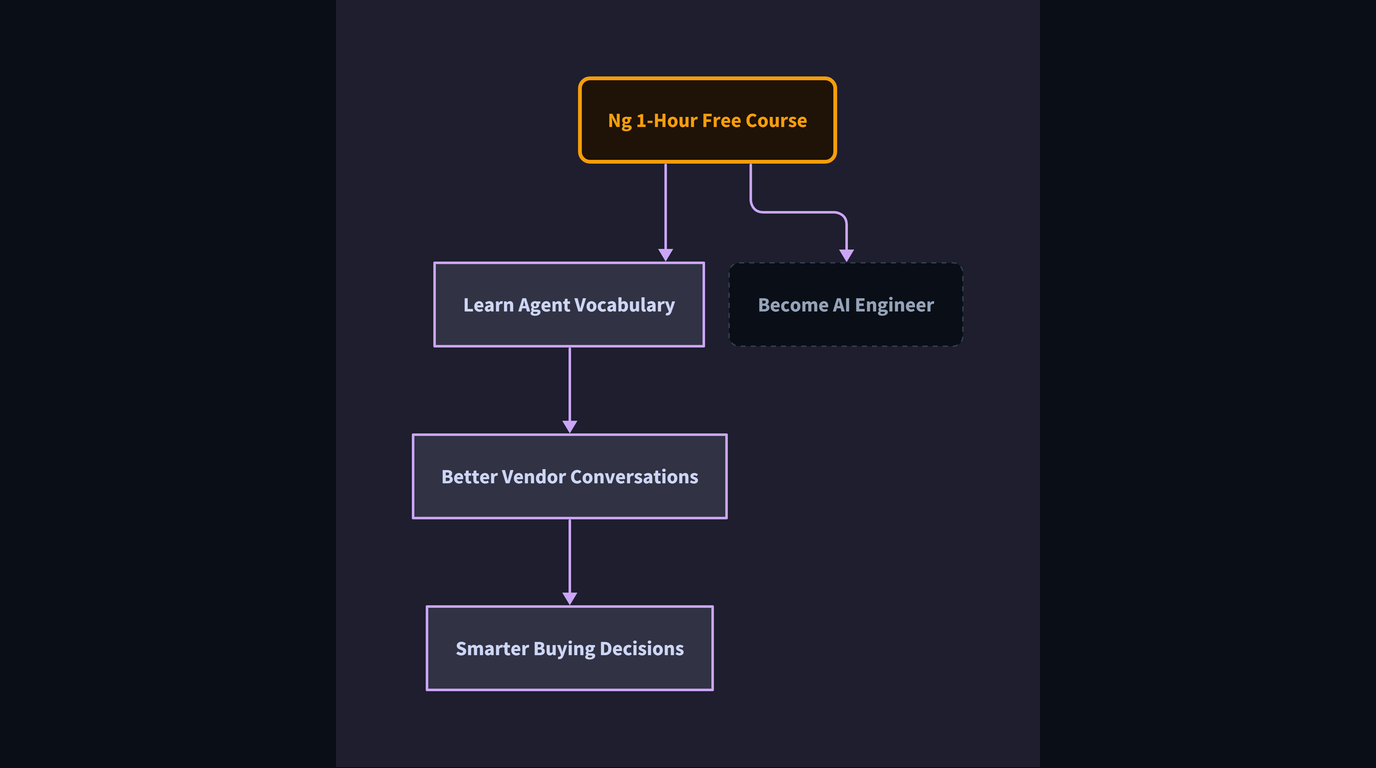
That matters because operators who understand the vocabulary can have better conversations with the vendors, developers, and internal teams they are already working with. A real estate brokerage director who understands what a “multi-agent system” (multiple AI agents handing tasks between each other, like a relay race, rather than one AI doing everything) actually is will make a smarter buying decision than one who nods along in a sales call. A SaaS company’s ops lead who can distinguish between a basic AI workflow and a self-improving loop (an agent that monitors its own outputs and adjusts its behavior over time) will catch vendor overpromising before signing a contract.
You do not need to build anything to benefit from understanding this. But you do need to understand it.
What most people get wrong
The viral framing around this course, and most content like it, is aimed at people who want to become AI engineers. “Don’t waste two years” is a career pitch, not an operator pitch. So most business leaders scroll past it.
That is a mistake. The content underneath the career framing is a clear map of how modern AI systems are actually structured. And operators who skip that map end up dependent on whoever is selling them something to explain it. That is a bad position to be in when the thing being sold is expensive, fast-moving, and genuinely hard to evaluate from the outside.
The comments on the viral post also illustrate a second common mistake: getting stuck on credentialing instead of content. Whether Ng holds the right title is irrelevant to whether the course teaches useful concepts. Evaluating ideas by the reputation of who said them, rather than by the ideas themselves, is exactly the kind of shortcut that leads to bad AI decisions at the organizational level.
There is a third mistake hiding in the enthusiasm. One commenter called the content outdated. That is worth taking seriously, not dismissing. The agent design patterns Ng covers are real, but the tooling around them shifts quickly. Treat any course in this space as a conceptual foundation, not a step-by-step build guide. The concepts age better than the specific tools.
The actual takeaway
One hour of structured education on agentic AI now exists, is free, and covers the full arc from basics to multi-agent systems. That is a low barrier. The operators who take it will not walk away as engineers. They will walk away knowing enough to ask sharper questions, read vendor claims more critically, and recognize when a proposed AI solution is genuinely sophisticated versus dressed-up automation with a bigger price tag.
That kind of literacy compounds. It does not require a background in machine learning. It requires about sixty minutes and the willingness to sit with unfamiliar vocabulary until it clicks.
If you want help thinking through what agentic AI actually looks like in your operation, and what questions to ask before committing to anything, xovionlabs.com is a good place to start.