Anthropic Just Made Its Mid-Tier Model the One to Beat
Claude Opus 5 landed today with benchmark scores that outpace every model in its class at half the cost of Fable 5. Here is what the pricing and performance shift actually means for operators building on AI right now.
The Signal #055 — Dakota’s read on the AI news that actually matters to people running a business.
For the past year, the mental model most operators have used goes something like this: if you need the smartest possible output, you pay for the top model. If you need speed and cost efficiency, you step down and accept the tradeoff. That mental model just got more complicated.
Anthropec shipped Claude Opus 5 today. And based on the numbers in the announcement, it does not behave like a mid-tier model.
What happened
Anthropec published the Claude Opus 5 announcement on July 24, 2026. The short version: Opus 5 is now the default model on Claude Max and the strongest model on Claude Pro. It is priced the same as its predecessor, Opus 4.8, which means the cost did not go up. The performance did.
A few numbers worth knowing.
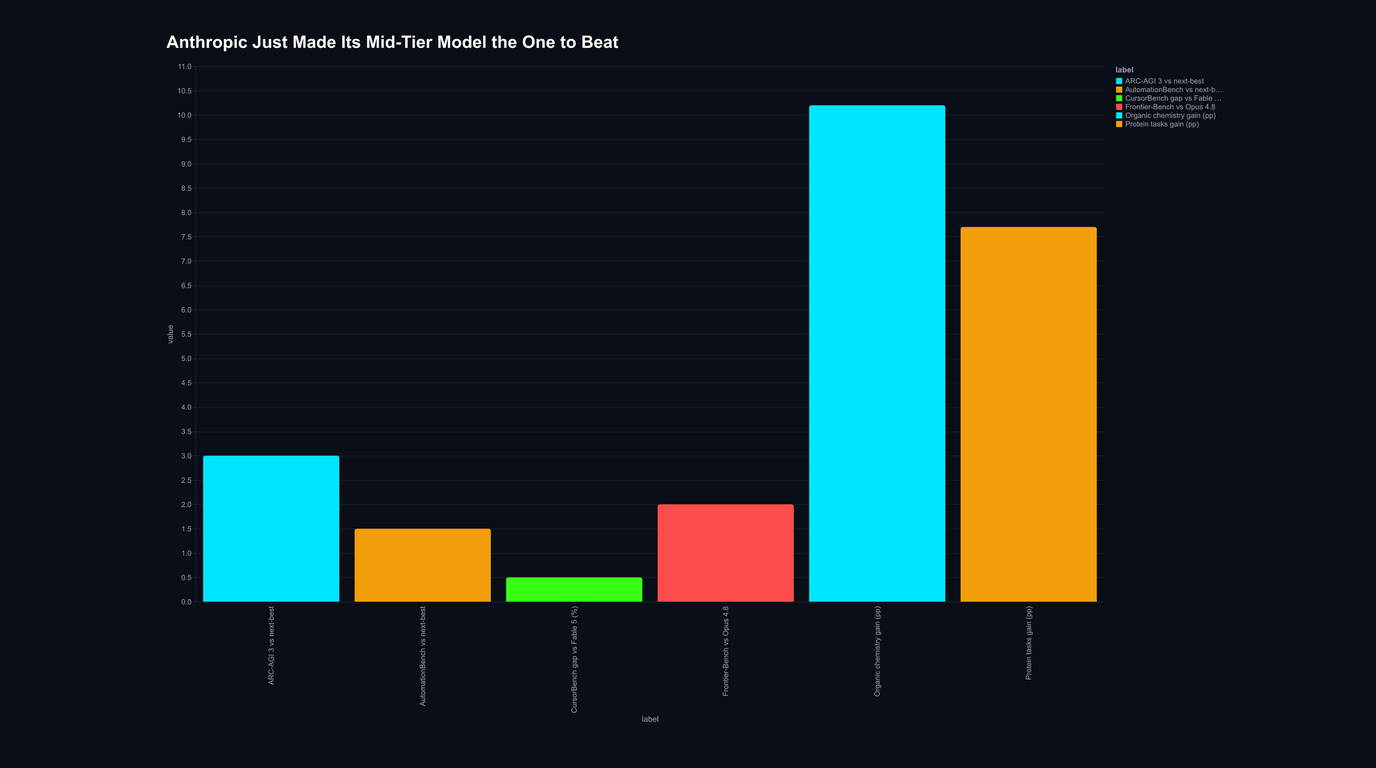
On Frontier-Bench v0.1, a coding and software engineering evaluation, Opus 5 surpasses all other models and more than doubles Opus 4.8’s performance at a lower cost per task. On CursorBench 3.2 at max effort, it performs within 0.5% of Fable 5’s peak score at half the cost per task. On ARC-AGI 3, which tests a model’s ability to solve novel problems it has not seen before, Opus 5 scored three times as high as the next-best model. On OSWorld 2.0, a computer use benchmark, Opus 5 surpasses Fable 5’s best result at just over a third of the cost.
On Zapier’s AutomationBench, which measures whether a model can complete real business tasks from start to finish, Opus 5’s pass rate is around 1.5 times the next-best model for the same cost per task. Even at its lowest effort setting, it passes more tasks than any other model tested.
Anthropec also published some real-world examples. One involved a trading firm engineer who used Opus 5 to build a market data feed for a new exchange in a single session. Previous models could not complete the task at all, even with detailed plans provided. Another example: given a real bug in a popular open-source package manager, Opus 5 found the root cause and fixed an edge case that the community’s own patch had missed. A competing model fixed only the surface symptom and reported the bug resolved.
The life sciences results are notable too. Opus 5 scores 10.2 percentage points higher than Opus 4.8 on organic chemistry tasks and 7.7 percentage points higher on protein-related tasks.
Why it matters for operators
The practical question most operators ask when a new model drops is simple: does this change what I should be running, and does it change what I should be paying?
In this case, both answers lean toward yes.
The effort setting (a parameter that controls how hard the model works on a task, trading speed and cost against quality) is the part worth paying attention to. Anthropec built Opus 5 to let operators tune that dial. If you are running high-volume, lower-stakes tasks, like drafting routine emails, summarizing incoming documents, or triaging a support queue, you can drop the effort setting and spend less. If you are running complex, high-stakes work, like financial analysis, contract review, or agentic coding tasks (where the model takes a sequence of steps on its own rather than answering a single question), you push the effort up and still come in at roughly half the cost of Fable 5.
For a SaaS company running AI inside their product, that pricing flexibility is meaningful at scale. For a healthcare operation using AI to assist with research or documentation, the life sciences performance improvements are worth evaluating directly. The point is that the tradeoff that made operators default to a more expensive model has gotten smaller.
What most people get wrong
The mistake operators make with announcements like this is treating benchmark scores as the whole story.
Benchmarks tell you how a model performs on specific, structured tests. They do not tell you how it performs on your prompts, your data, and your workflows. A model that scores near the top on a coding benchmark might still behave inconsistently when it hits the edge cases inside your specific codebase. A model that aces business automation tests might still require careful prompt engineering (the practice of writing clear, structured instructions so the model behaves predictably) before it works reliably in your environment.
The Lovable team noted something that cuts against the benchmark hype directly. They called out consistency as the thing that actually matters in production: “Reliable results, build after build.” They reported that Opus 5 is steadier, with far less variance run to run, and 22% better than Opus 4.7 on their hardest agentic coding tasks. That combination of capability and consistency is harder to fake on a leaderboard and harder to find in practice.
So the benchmark numbers are a reason to evaluate Opus 5. They are not a reason to assume it will work the same way in your stack without testing.
The actual lesson here
Frontier intelligence is getting cheaper, faster than most operators expected. A year ago, the performance Opus 5 is posting today would have required the most expensive model in the lineup. Today it comes at the mid-tier price point.
That pattern is not slowing down. Which means the operators who build repeatable processes for evaluating and adopting new models will keep finding cost and capability improvements that their competitors are slower to capture. The model itself is not the moat. Knowing how to put it to work is.
If you are thinking through what this shift means for your AI setup, the team at xovionlabs.com is worth a conversation.