China's Open AI Strategy Is Beating America's Closed One
Chinese AI labs are releasing models openly and freely while American companies lock theirs down. Here is what that strategic split actually means for operators making AI decisions today.
The Signal #051 — Dakota’s read on the AI news that actually matters to people running a business.
There is a story developing in AI that has nothing to do with benchmarks or chatbots. It is a story about distribution strategy. And right now, the side you might expect to be losing is winning.
What happened
A piece by Ben Werdmuller, “American AI is locked down and proprietary. It’s losing.”, makes a case that is worth reading carefully if you are making any infrastructure or tooling decisions right now.
The argument is not that Chinese AI models are technically superior. It is that China’s decision to release models openly, as free-to-use weights (meaning the core model files you can download, run, and modify on your own hardware), is a better distribution strategy than what American companies are doing.
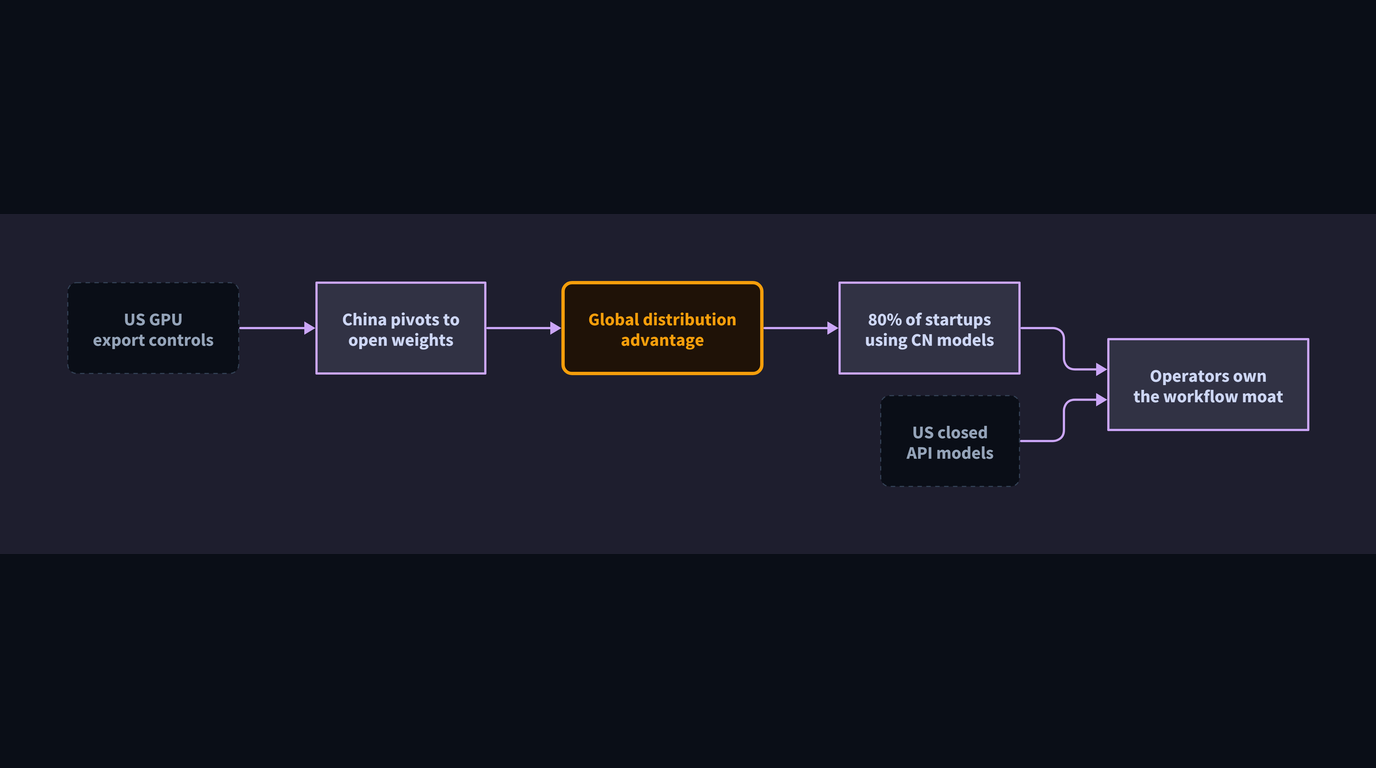
Here is the specific dynamic. The US placed export controls on GPUs, which limits China’s access to the high-end chips used to train massive models. That sounds like a win for American AI. But Werdmuller argues it actually pushed Chinese labs toward an open release strategy, which turns a compute disadvantage into a distribution advantage. If you can not run global centralized services at the scale of OpenAI, you release the model and let everyone else run it. Suddenly your model is everywhere.
The result: a16z partner Martin Casado noted in the Economist that there is an 80% chance that any given startup is already using Chinese models. Meanwhile, Moonshot and Alibaba have unveiled models they claim can compete with the best from OpenAI and Anthropic at a fraction of the cost.
The gap that American frontier models relied on is closing. Fast.
Why it matters for operators
If you are running any kind of operation that touches AI, the closed versus open split has real, practical consequences.
Open-weights models are portable and permissionless. You can run them on your own servers, inside your own firewall, without sending data to a third-party API. For a healthcare organization worried about patient data, or a legal firm worried about client confidentiality, that portability is not a minor feature. It is the whole ball game.
The switching cost argument matters here too. Werdmuller makes the point plainly: someone could be using ChatGPT today and Claude tomorrow with very little impact on their workflows. In the engineering world especially, where models are accessed via API (a connection point your software uses to talk to the model), you can swap the API and use the same prompt. The model itself has almost no technical lock-in.
What that means for you as an operator is that the model is rarely the moat. The workflow you build around it is. The integrations, the institutional knowledge baked into your prompts, the processes your team has learned, those are what create stickiness. Not which company’s logo is on the model.
If a capable open-weights model lets you run the same quality of output at lower cost, with better data control, the rational move is to at least evaluate it. The fact that it comes from a Chinese lab is a legitimate concern worth thinking through, and Werdmuller acknowledges that directly, pointing to the real issue of how these models might reflect Chinese government perspectives on sensitive topics. But that concern is separate from the strategic question of what the shift toward open models means for how AI infrastructure gets adopted globally.
What most people get wrong
Most operators treat AI vendor selection like they are picking enterprise software. They assume switching is painful, that the model they start with is the model they are probably stuck with, and that the brand matters more than the architecture underneath.
None of that is really true right now.
The more useful mental model is this: the model layer is becoming a commodity. Werdmuller puts it directly, noting that AI models as a product have very little moat beyond brand loyalty and superficial switching costs. The real value accumulates in the services, integrations, and workflows sitting around the model, not in the model itself.
This is important because a lot of operators are over-investing in picking the perfect model and under-investing in building the workflow logic that actually makes the model useful to their team. That is the wrong priority order.
And on the open versus closed question specifically: open almost always wins when it comes to infrastructure adoption. Open technologies can be used permissionlessly, hosted where you want, and modified to fit specific use cases. That pattern has played out across decades of software history. There is no obvious reason AI infrastructure will be different.
The short version
China’s bet on open-weights model distribution is not a technical story. It is a go-to-market story. And it appears to be working. For operators, the lesson is not which country to root for. It is that the model you use matters less than the workflow you build around it, your data stays wherever you put it, and the switching costs you assume exist are probably lower than you think.
If you are making AI infrastructure decisions and want to think through what open versus closed actually means for your specific setup, the team at xovionlabs.com is happy to help you work through it.