Anthropic Just Made Its Best Model 25% Cheaper. Here Is What Operators Should Actually Read Into That.
Claude Fable 5.1 and Mythos 5.1 are out, with a 25% price cut on typical workloads and up to 45% savings on agentic tasks. Here is what that pricing shift means for operators making AI infrastructure decisions right now.
The Signal #084 — Dakota’s read on the AI news that actually matters to people running a business.
Price cuts on frontier AI models are becoming a pattern worth tracking. Not because cheaper is always better, but because the reasons behind the cuts tell you something useful about where the whole stack is heading.
This week, Anthropic released Claude Fable 5.1 and Claude Mythos 5.1. There is a lot in the announcement. Most of the coverage will focus on benchmark numbers. That is fine. But if you are running a business that already uses or is evaluating AI for real work, the pricing structure and the data policy changes deserve more attention than they are probably getting.
What happened
Fable 5.1 and Mythos 5.1 are the same underlying model. The difference is safeguards. Fable 5.1 is generally available. Mythos 5.1 runs stricter safeguards tuned for cybersecurity and life sciences work, and it is available only through Anthropic’s trusted access programs.
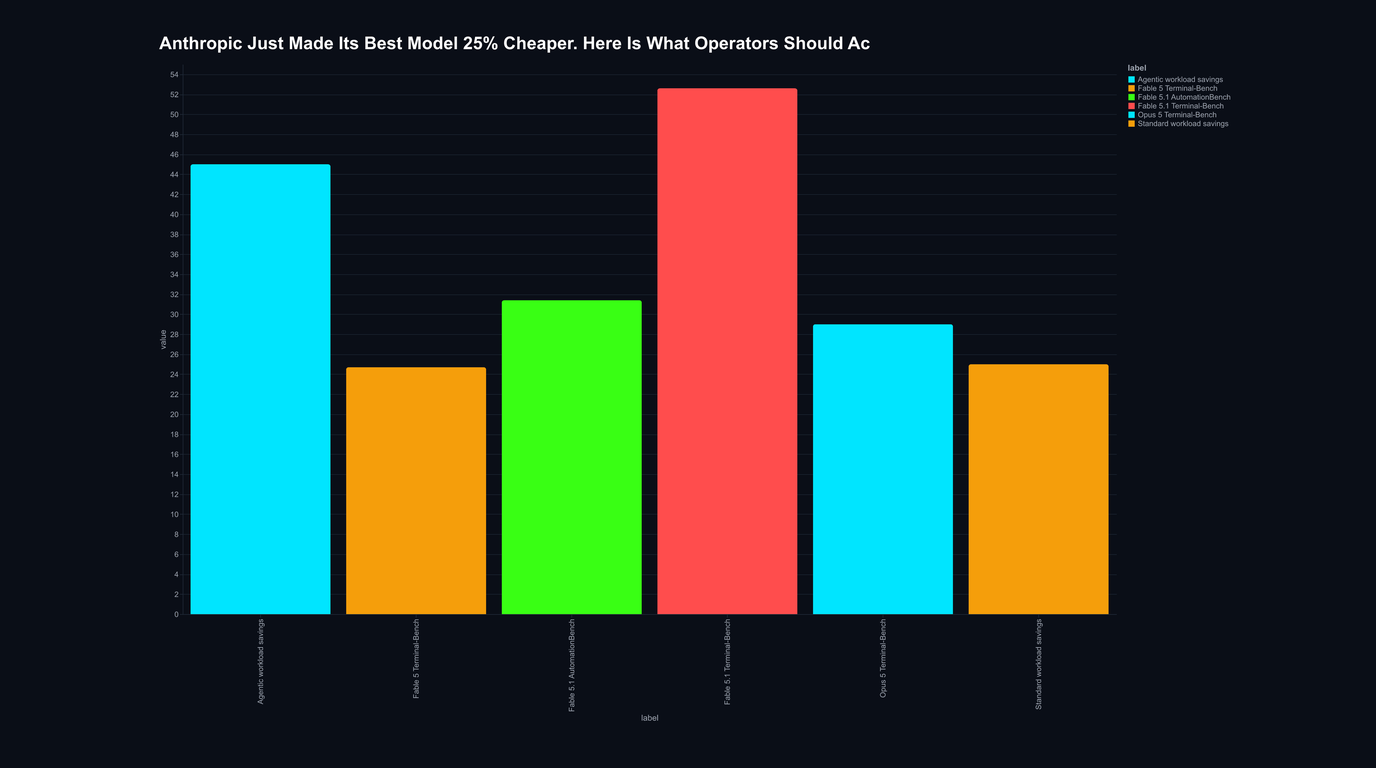
On performance, the numbers are real. Fable 5.1 scores 52.6% on Terminal-Bench-Science 0.1, compared to 24.7% for Fable 5 and 29.0% for Opus 5. On CursorBench 3.2.0, it hits 73.4% against Fable 5’s 70.5%. On Humanity’s Last Exam with tools enabled, it reaches 65.0%. On AutomationBench, it scores 31.4% against Fable 5’s 17.1%. Those are meaningful jumps, not incremental ones.
The pricing change is driven by one specific thing: Anthropic is reducing the cost of cache reads. A cache read is what happens when the model processes inputs it has already seen and stored, instead of processing them fresh. For standard workloads, that adds up to roughly 25% less than Fable 5. For highly agentic work (meaning multi-step AI tasks where the model is running through long sequences of actions on its own), Anthropic says the savings can reach approximately 45%.
On data retention, Anthropic is introducing what it calls Enterprise Frontier Safeguards, or EFS. The short version: enterprise customer data gets stored in infrastructure the customer controls, not Anthropic. The result is effectively a zero data retention policy without the customer having to negotiate a separate agreement. EFS rolls out in phases starting later this fall. Until then, eligible customers can use Fable 5.1 with zero data retention anyway.
One concrete example Anthropic shared: Fable 5.1 found the root cause of a rare crash in internal systems at investment firm Millennium, a crash that the firm’s engineers and every other model had failed to explain over several years.
Why it matters for operators
The cache read pricing change is the most operationally interesting piece here. Most operators who have built anything with these APIs know that cost is not just about the model tier you pick. It is about how often you are re-sending the same context (the background information, instructions, or history the model needs to do its job) on every call.
Agentic workflows are expensive partly because they repeat context constantly. Every step in a multi-step task usually sends a chunk of prior conversation or instructions back through the model. If cache reads are getting cheaper, the economics of those workflows change materially, not just at scale but at the level of a single mid-sized team running a few automated processes.
For a SaaS company, that might be an AI that handles support escalation logic across long ticket histories. For a law firm, it might be a document review workflow that re-reads the same case background on every pass. The specific vertical does not matter much. What matters is whether your AI tasks involve repeated context. If they do, 45% is worth pulling out a spreadsheet for.
The EFS data policy change matters most for regulated industries and enterprise buyers who have been slow to commit because of data handling concerns. That friction point just got smaller.
What most people get wrong
The benchmark numbers will dominate the conversation, and operators will spend time debating whether 52.6% versus 24.7% on Terminal-Bench-Science means they should switch tools. That is mostly the wrong question.
Benchmarks tell you what a model can do under controlled test conditions. They do not tell you what it will do inside your specific workflow, with your specific data, under your specific latency and cost constraints. Fable 5.1 also ships with adjustable effort levels, from Low to Max, and the costs per task shift significantly depending on which level you run. A model scoring well at Max effort is not the same story as what you will actually pay when you dial it to Medium for routine work.
The effort level system is something operators should actually read carefully. Fable 5.1 defaults to High effort in Claude Code and Medium in Claude Cowork and on Claude.ai. Those defaults were chosen deliberately. Running everything at Max because the benchmark looks good there is a fast way to spend more than you need to.
The other thing people tend to skip over is the false positive reduction on safeguards. Anthropic says Fable 5.1 blocks 60% fewer false positives in cybersecurity than previous versions. A false positive here means the model flagging or refusing something that was actually fine. If your team has been working around those refusals, that is a real workflow cost that just dropped.
The actual lesson
AI pricing is not stable. It is compressing, and the compression is coming from multiple directions at once. The right response for an operator is not to wait for the market to settle. It is to understand your own cost structure well enough to know when a change like this one actually applies to you.
Cache reads matter if your workflows repeat context. Effort levels matter if you are paying for capability you do not need on every task. Data retention matters if it has been a blocker. None of those are universal. All of them are worth knowing.
If you want help thinking through where AI fits your operation without the noise, xovionlabs.com is a good place to start.