Customers Don't Want to Be Transformed. They Want the Thing Done.
A viral post from Jason Freedman is a clean diagnosis of why so many AI pitches miss. Operators, here is what customers are actually buying when they hand over money.
The Signal #081 — Dakota’s read on the AI news that actually matters to people running a business.
There is a tell in a lot of AI pitches right now. The demo opens on a gorgeous interface. The workflow looks slick. Someone explains how everything exports to .md files. The presenter is proud of what they built, and they should be. But the person across the table is thinking about something else entirely.
They are thinking about a problem on their to-do list that they want gone.
What happened
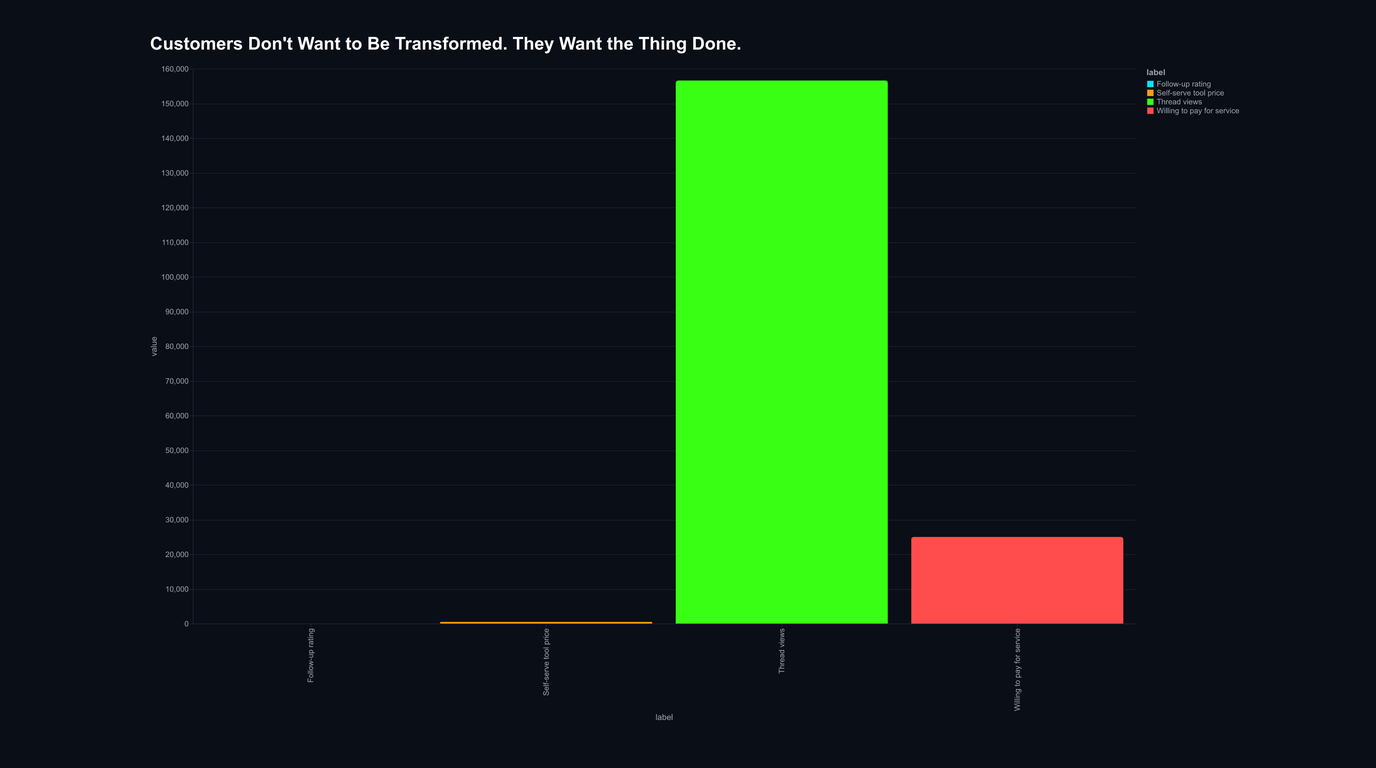
On August 27, Jason Freedman posted a thread on X that pulled 156,600 views. He had just been pitched as a potential customer, not an investor, by an AI startup. They showed him their UI, their AI workflow, their export options. He walked away cold.
Here is the part worth reading twice. Freedman said he was willing to pay around $25,000 to an analyst or a services shop to solve the problem. The startup wanted to charge him around $500 for access to their self-serve tool. His response was not that they were too expensive. It was that he would rather pay the full $25,000 if someone would simply do the work for him.
He sent them an email. The line that landed: “My goal is have the problem solved for me with money, and the bare minimum of my time. AI advice seems nice, but was not my ask. In fact, a huge plus would be for me to never have to interact with any AI service personally.”
He also invoked a Paul Graham essay called Schlep Blindness, which argues that founders avoid the hard, unglamorous, hands-on work that actually earns customers, and build tools instead because tools feel scalable and clean.
The story did not end badly. A different founder contacted Freedman ten minutes after the post went up, said he would spend a couple of hours working on the problem that night, and met with Freedman in person the next day. The original startup that received the critical email also reached out, took the feedback seriously, and Freedman called the follow-up conversation a 10 out of 10 for how to handle tough criticism.
Why it matters for operators
If you are buying AI-powered services right now, Freedman’s post names something you may have felt but not said out loud. A lot of what gets pitched as an AI solution is actually a self-serve platform (a tool you log into and operate yourself) dressed up in a modern interface. The AI is doing work inside the tool. But you are still doing the work of learning the tool, prompting the tool, interpreting the output, and deciding what to do next.
That is not nothing. But it is also not the same as handing a problem to someone and getting a result back.
Operators in professional services, research, finance, real estate, and dozens of other fields are sitting on problems that could be solved by a combination of AI capability and human judgment. The question is who owns that combination. If the answer is “you do, once you learn our platform,” that is a different purchase than “we do, and here is the deliverable.”
Knowing which one you are buying matters before you sign anything.
What most people get wrong
The instinct in the AI space right now is to build tools, not to do work. Tools feel like they scale. You build once, you sell many times, the margin looks clean on a spreadsheet. Doing the actual work feels expensive and hard to grow.
But Freedman’s thread points at something real. There is a customer segment willing to pay significantly more for a done-for-you result than for a do-it-yourself platform. That segment is not small. It is every busy operator who has budget, has a problem, and does not have time to become a power user of another piece of software.
The AI-native businesses that figure out how to close that gap, using AI to do the work at a cost structure that still makes sense, while delivering the outcome the customer actually asked for, are going to find a lot less price resistance than the ones competing purely on interface.
Schlep Blindness, as Graham defines it, is the tendency to avoid problems that feel unpleasant or manual. The pitch that led to Freedman’s post is a clean example. The startup built something impressive and avoided the schleppy part: actually solving the customer’s specific problem with their own hands.
The short version
Customers do not hire tools. They hire outcomes. AI makes it possible to deliver those outcomes faster and at better margins than before. But the customer still has to receive a result, not an invitation to a dashboard.
If your AI pitch requires the buyer to change how they work, learn a new interface, or interact with an AI system directly, you are selling a different thing than you might think you are selling. Sometimes that is fine. Just be honest about which one it is.
Want to think through how AI fits your actual operations without the platform-first pitch? Start at xovionlabs.com.