Developers Built an Open Source CEO. Here Is What Operators Should Actually Take From That.
After a wave of tech layoffs blamed on AI, developers shipped OpenExecutive, an open-source virtual executive team backed by 8 specialist Claude agents. Here is what the architecture reveals about where AI coordination is actually headed for operators.
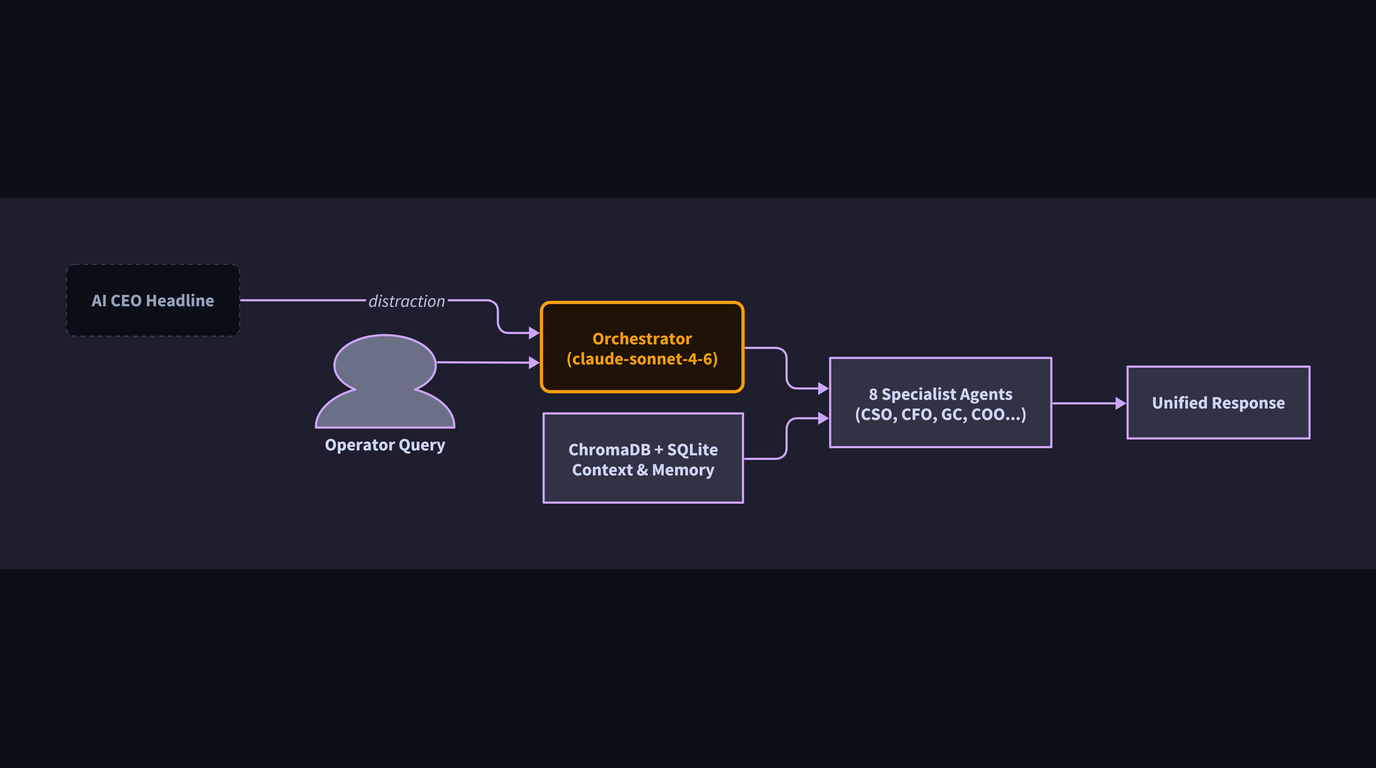
Inside the open-source AI executive team
The interesting part is not that developers built an “AI CEO.” It is how one operator question gets routed through specialist context, memory, and eight different executive roles — then comes back as one answer.
“Can you review this vendor contract before I sign it?”
Claude Sonnet 4.6 routes the question
Legal leads. Finance and operations are pulled in because contract terms can change cash exposure and execution risk.
Your financials, contracts, roadmap and company documents are stored for similarity search.
Key decisions and prior advice carry into the next session instead of disappearing after each chat.
“The contract is legally workable, but the termination clause creates operating risk and the payment timing could tighten cash flow. Renegotiate those two sections before signing.”
The system helps think through the decision. It does not independently run the company.
The Signal #080 — Dakota’s read on the AI news that actually matters to people running a business.
The story has a sharp irony to it. A CEO fires developers to make room for AI. The developers, apparently with some time on their hands, build an open-source AI CEO.
That is the headline. But if you stop there, you miss the part that actually matters for anyone running a business.
What happened
A team at SenteLabs shipped OpenExecutive, an open-source project that acts as a virtual executive team for your company. The repo has 1,300 stars and 77 forks as of this writing. The project runs on FastAPI and Next.js, uses Anthropic’s Claude API as its backbone, and is released under the Apache 2.0 license, meaning you can self-host it and modify it freely.
Here is the architecture in plain terms. When you send a message, an orchestrator model, running on claude-sonnet-4-6, routes your question to whichever specialist agents are relevant. There are eight of them: a Chief Strategy Officer, a Chief Financial Officer, a Chief HR and People Officer, a General Counsel, a Chief Operating Officer, a Chief Marketing Officer, a Chief Product Officer, and a Board Communications Director. The four heaviest thinkers, the CSO, CFO, GC, and Board Director, run on claude-opus-4-7 with extended thinking enabled for deeper reasoning tasks. All eight specialists pull context from ChromaDB (a vector database, meaning it stores information in a format optimized for similarity search rather than exact keyword lookup). You feed it your own company documents, and those get chunked and stored separately from the built-in MBA-level knowledge the system ships with.
The design has two features worth highlighting. First, episodic memory. After every response, a lightweight background model extracts key decisions and advice into SQLite (a lightweight local database). The next session opens with a block summarizing what the system recommended last time. It does not start from scratch each conversation. Second, prompt caching. The system is structured so that the executive persona, your company profile, and the knowledge index are cached separately, giving the project an up to 85% cache hit rate after the first few turns. That matters for cost and speed.
You get one voice back from all of it. The internal routing across eight agents is never exposed to you.
Why it matters for operators
Forget the CEO joke for a moment. What OpenExecutive actually demonstrates is a multi-agent coordination pattern (a setup where several specialized AI models work in parallel and hand results to a single output layer) that is becoming easier to build and deploy.
That pattern solves a real problem. A single general-purpose AI model asked to analyze a contract, model cash flow, and write a board memo in the same session tends to produce shallow answers on at least one of those. It is not built to hold deep domain knowledge and apply it simultaneously across very different disciplines. Routing to specialists and synthesizing the outputs is how you get depth without making the operator manage which model to ask for which task.
For a small professional services firm, a SaaS company running lean, or a solo operator who does not have a full leadership team sitting around a conference table, a system like this represents genuine access to structured strategic thinking that was previously gated behind expensive consultants or headcount. You upload your financials, your contracts, your product roadmap, and the system builds context around your actual business rather than answering in generic terms.
The episodic memory piece is underrated. Most AI tools treat every session as the first one. A system that remembers what it told you last month about a vendor negotiation, and can surface that context when the topic comes up again, behaves more like an advisor and less like a search engine.
What most people get wrong
The easy mistake is to read a project like this and think the takeaway is automation. Replace the exec. Cut the headcount. Let the system run.
That is not what the architecture is actually built for. Look at the quick start. You run it locally. You feed it your documents. You ask it questions. It responds. There is no autonomous loop here dispatching decisions on your behalf while you sleep. The scheduler surfaces follow-ups and time-sensitive actions, but a human is still in the chair making the call.
The more accurate read is that this is a thinking tool, not a doing tool. It helps an operator ask better questions, stress-test a decision from multiple functional angles, and keep institutional memory across conversations. That is useful. It is also very different from handing over the wheel.
The other common mistake is assuming you need something this elaborate to get value from multi-agent coordination. You probably do not, at least not yet. The pattern matters more than the product. Understanding that routing a complex question through specialized context produces better outputs than asking one model to do everything is the insight worth carrying into your own workflows, whatever your stack looks like.
One tool does not replace strategic judgment. But a well-structured AI system can make the person exercising that judgment significantly better informed.
If you want to think through how agent coordination patterns fit into what you are actually building, xovionlabs.com is a good place to start.