Every Major Tech Giant Now Backs Open AI Models. What Operators Should Actually Think About That.
Google has publicly come out in favor of open-weight AI models, leaving Anthropic increasingly isolated in the closed-model camp. Here is what the alignment of Microsoft, Meta, Google, and others actually means for operators making AI infrastructure decisions.
The Signal #056 — Dakota’s read on the AI news that actually matters to people running a business.
The sides are becoming clearer.
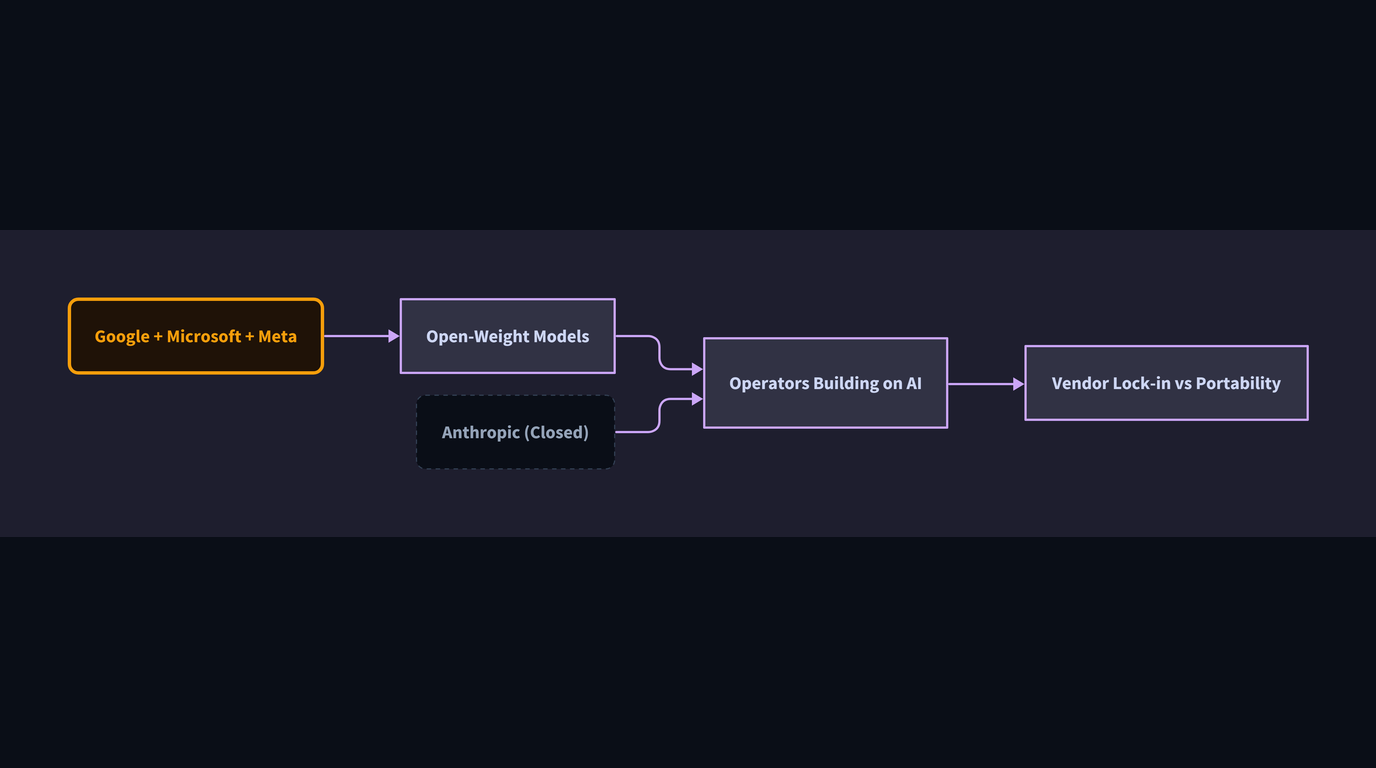
Google has publicly come out in favor of open-weight AI models. That puts Microsoft, Meta, Google, and most of the major cloud infrastructure players on one side of a philosophical and commercial divide. On the other side sits Anthropic, which has consistently argued that closed, safety-tested models are the responsible path forward. That is not a small split. It is the entire industry sorting itself into two camps, and operators who are building anything on top of AI infrastructure right now are caught in the middle of it.
This is worth understanding clearly, not because you need to pick a side today, but because the side that wins will shape what your options cost and what they look like three years from now.
What happened
Discussion surfaced this week on r/LocalLLaMA pointing to Google’s public support for open-weight models (models where the trained weights, meaning the actual numerical parameters the AI learned during training, are released publicly so anyone can run or modify them). The thread frames it plainly: it is now effectively every major tech giant versus Anthropic.
Meta has been shipping open-weight models under the Llama name for years. Microsoft has been investing in and distributing those models through Azure. Now Google is adding its voice to that side. Anthropic remains the notable holdout, defending the position that proprietary, closed development is the safer and more controllable approach.
The alignment here is not purely ideological. These companies have real commercial reasons to support open weights. Open models drive cloud compute consumption. They build developer ecosystems around existing platforms. They reduce any single competitor’s ability to own the model layer outright. The incentives and the stated values happen to point the same direction, which is worth noting.
Why it matters for operators
If you are running a business that is starting to depend on AI, the closed versus open question is not abstract. It is a vendor concentration question.
When you build a workflow on a closed API (an application programming interface, meaning the connection point where your software talks to the AI model), you are renting access to someone else’s infrastructure on their pricing schedule. When that provider changes prices, restricts use cases, or goes down, your workflow goes with it. A lot of operators learned this the hard way when OpenAI adjusted rate limits or when Anthropic shifted plan structures. The dependency is real.
Open-weight models change that calculus. A manufacturer building quality-control tooling, a healthcare admin team automating prior authorizations, a real estate brokerage running a document review pipeline. Any of them can, in principle, run an open-weight model on their own infrastructure or through a commodity cloud provider, and not be subject to one company’s pricing decisions. That option now has Google’s weight behind it, which means it will get better tooling, better documentation, and more enterprise support over time.
None of that means open-weight is automatically the right call for every operator today. Running your own model infrastructure requires real technical capacity. But the trajectory matters. The ecosystem around open models is about to get a lot more mature.
What most people get wrong
Most operators hear “open source AI” and think it means cheap but second-rate. That assumption is outdated.
The performance gap between frontier closed models and the best open-weight alternatives has been narrowing steadily. For a wide range of practical business tasks, the difference in output quality is small or nonexistent. Where closed models still lead is typically on the most complex reasoning tasks, long-context work, and very recent knowledge. For structured workflows, classification, summarization, drafting, and retrieval-augmented tasks, open-weight models are already competitive.
The other thing people get wrong is treating this as a binary. You do not have to choose one model and commit forever. The smarter move is understanding what each type of model is good for, and routing tasks accordingly. A SaaS company might use a closed frontier model for its highest-stakes customer-facing interactions and an open-weight model for internal tooling and batch processing. That kind of hybrid thinking is what the market is moving toward.
Backing from Google makes that hybrid approach easier to justify internally, and easier to build infrastructure around.
The lesson
The open-weight side of the market just got a lot more credible, not because of a single model release, but because the institutional weight behind it shifted. For operators, the practical question is not which side is right. It is whether your current AI dependencies are as flexible as your business needs them to be.
Vendor concentration is a risk like any other. Worth mapping it now, before it becomes urgent.
If you want to think through what AI infrastructure choices actually mean for how your operation runs, xovionlabs.com is a good place to start.