Google's Workhorse Model Just Got Cheaper and Smarter at the Same Time
Gemini 3.7 Flash ships at half the price of 3.6 Flash with measurable gains in coding, document reasoning, and real-world workflow completion. Here is what that combination actually means for operators building or buying AI-assisted processes.
The Signal #069 — Dakota’s read on the AI news that actually matters to people running a business.
The usual pattern with AI model releases is a tradeoff. Smarter costs more. Cheaper means slower or less capable. You pick a lane.
Gemini 3.7 Flash does not follow that pattern. Google shipped it on August 13, 2026, just three weeks after 3.6 Flash, and it came in faster, more capable on several meaningful benchmarks, and at an introductory price that cuts the per-token cost in half. That combination is worth paying attention to, because it changes the math on what is worth automating.
What happened
Google released Gemini 3.7 Flash and positioned it as their primary workhorse for coding and agent work. The introductory price is $0.75 per million input tokens and $3.75 per million output tokens. That pricing holds through the end of 2026, after which it moves to $1.50 and $7.50 respectively.
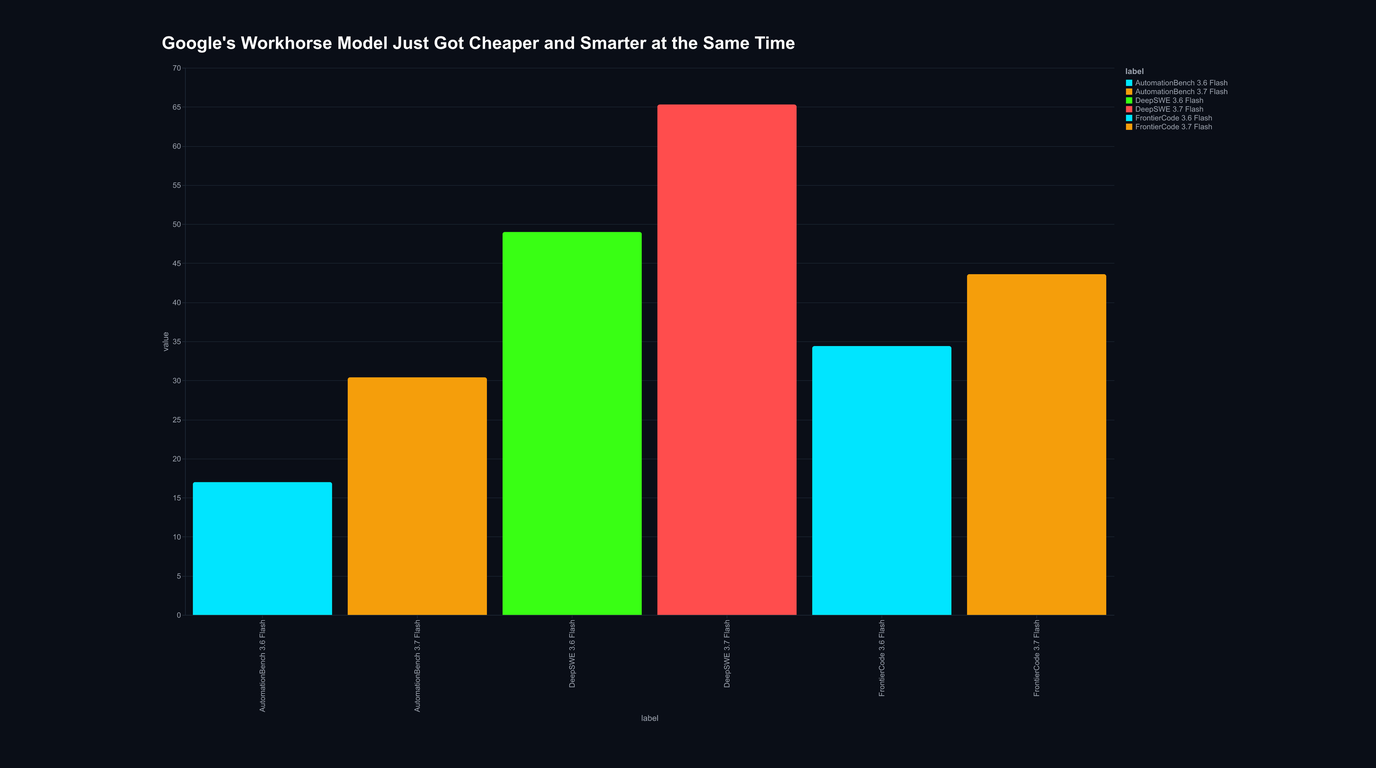
The benchmark numbers tell a specific story. On FrontierCode 1.1 Main, which tests coding accuracy, 3.7 Flash scores 43.6% versus 34.4% for 3.6 Flash. On DeepSWE v1.1, a software engineering benchmark, it scores 65.3% versus 49.0%. On WebDev Arena, it posts an Elo score of 1588 versus 1538 for the prior version.
The gains outside of coding are worth noting too. On the GDP.pdf benchmark, which tests a model’s ability to process complex documents, 3.7 Flash scores 34.0% versus 22.0% for 3.6 Flash. That is a meaningful jump for anyone whose workflows touch dense PDFs, financial reports, or legal documents. On AutomationBench, which measures real-world business workflow completion, the model scores 30.4% versus 17.0%. Nearly double the prior version on the benchmark most relevant to operators trying to automate actual work.
Google also updated Gemini Spark, their 24/7 personal agent available to Google AI Pro and Ultra subscribers in over 160 countries, to run on 3.7 Flash starting the same day.
Why it matters for operators
The AutomationBench number is the one to sit with. A benchmark that tests real-world business workflow completion going from 17.0% to 30.4% is not a small jump in capability. It is the difference between a model that can handle the first step of a multi-part task and one that can see a process through more reliably without a human stepping in to unstick it.
Think about what that means practically. A legal operations team routing contracts through an AI review step needs the model to read dense language accurately and flag the right clauses, not just the obvious ones. A SaaS company using an agent to triage support tickets and draft initial responses needs the model to follow multi-step instructions with precision. A real estate brokerage pulling data from PDF market reports needs a model that can actually parse complex layouts, not just skim headers.
All of those workflows exist right now. Most of them have been limited by the model’s ability to complete the full task without breaking down partway through. A 30.4% AutomationBench score is not perfect, but it is a different operational reality than 17.0%.
The price drop compounds that. At $0.75 per million input tokens, running higher volumes through the model becomes financially viable in ways it was not at 3.6 Flash pricing. Workflows that were too expensive to run continuously can now be run continuously.
What most people get wrong
When a new model ships, most of the attention goes to the headline benchmark, usually something related to coding or a general reasoning test. Operators see the number, decide it sounds impressive, and either move on or immediately try to swap the new model into everything they have built.
Both responses miss the point.
The useful question is not which model scores highest on a leaderboard. It is which model completes your specific task more reliably at a cost that makes the workflow sustainable. The GDP.pdf benchmark matters more than general reasoning scores if your operation processes financial filings or insurance documents. The AutomationBench number matters more than code generation scores if you are trying to automate a multi-step internal process.
Models are tools with specific performance profiles. Matching the profile to the task is the operator’s job, and it requires knowing what your tasks actually look like in terms of document complexity, step count, and failure modes.
The other thing people get wrong is treating introductory pricing as the permanent baseline. The $0.75 input rate expires December 31, 2026. The math on your workflows should account for the January pricing of $1.50 per million input tokens and $7.50 per million output tokens. Build to the post-introductory numbers and treat the current rate as a window to test and scale.
The short version
A workhorse model getting meaningfully better at completing multi-step business workflows, while dropping in price, is the kind of news that changes deployment decisions. Not because of hype. Because the economics and capabilities of what you can automate reliably just shifted.
If you are evaluating where AI fits in your operations, or trying to figure out how to read model releases without getting lost in benchmark noise, xovionlabs.com is a good place to start.