Open Source AI Just Hit a Tipping Point. Here Is What That Actually Means for Operators.
A new industry report shows open-source AI models now handle the majority of production tokens worldwide. Here is what the capability and cost shift means for any operator making AI decisions right now.
The Signal #050 — Dakota’s read on the AI news that actually matters to people running a business.
Most conversations about AI models focus on which one is smartest. That is the wrong question for most operators.
The more useful question is: what does it cost, can you control it, and does it actually finish the job your workflow needs it to do? A new report published in July 2026 reframes the whole landscape around those questions. The numbers are worth sitting with.
What happened
The State of Open Source AI report, V1.0 dropped in July 2026 and covers the competitive gap between open-weight models (AI models whose underlying weights, or learned parameters, are publicly released) and closed models (proprietary systems where the company keeps the internals locked). The headline finding is blunt: the gap has nearly closed on most everyday workloads.
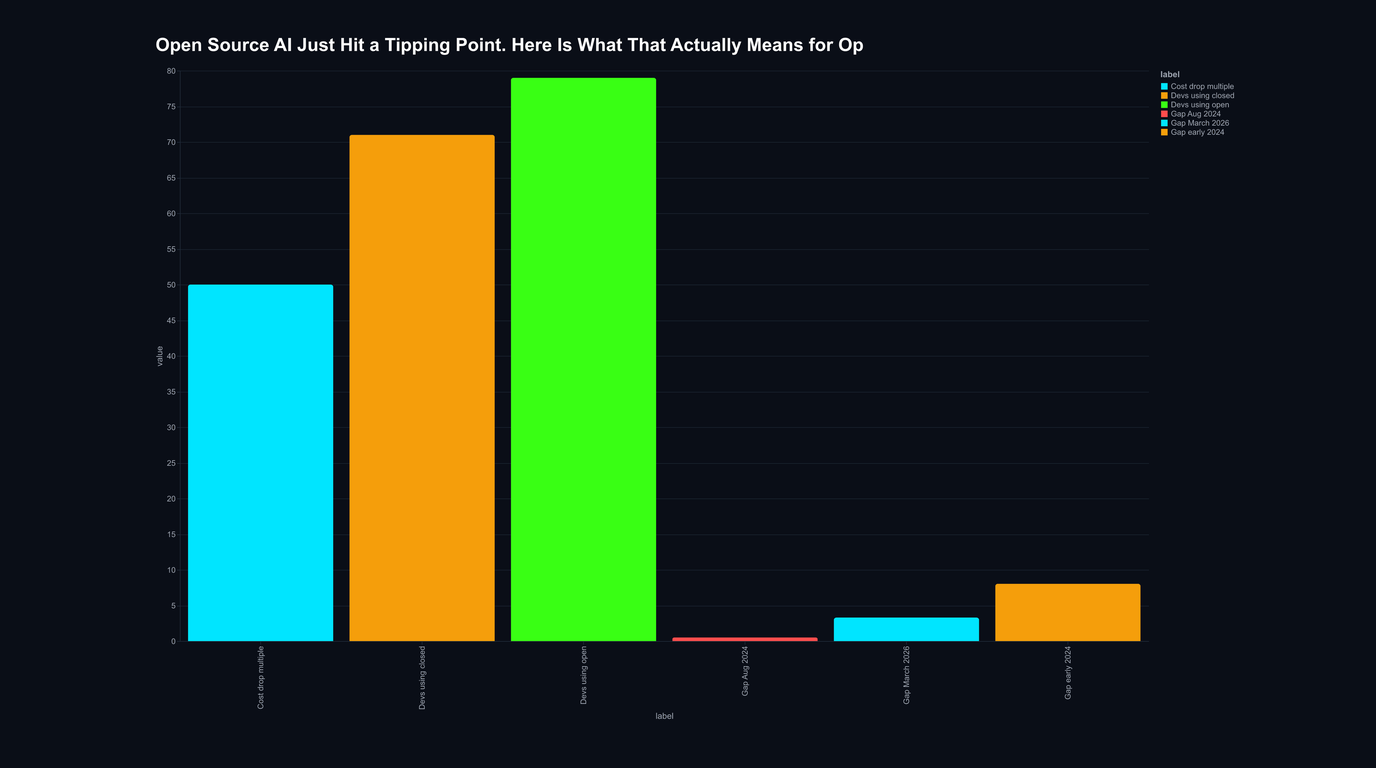
On the Chatbot Arena benchmark, the open-vs-closed capability gap went from 8.04% in early 2024 down to 0.5% by August 2024, briefly hit parity in February 2025 when DeepSeek-R1 matched the top US model, then reopened to 3.3% by March 2026 as closed reasoning models pulled ahead again. That 3.3% sounds meaningful until you read where it lives. Open models are at or near parity on coding, instruction-following, and general knowledge. The remaining gap concentrates in reasoning, long-context retrieval, and agentic tasks.
The cost story is equally significant. The price of running a GPT-4-class model dropped 50 times over 36 months, from 20 dollars to 40 cents per one million tokens (a token being a small chunk of text the model reads or writes). That is a faster decline than dotcom-era bandwidth costs.
On actual usage, open models now route a majority of tokens on OpenRouter (a public routing layer that sends AI requests to various models). The five highest-volume models on that platform are all open weights. By mid-2026, the top nine models route roughly 18 trillion weekly tokens for Chinese-built models against about 5.5 trillion for US-built ones.
Among developers, 79% of those adding AI functionality to applications use open models, versus 71% for closed. Half of all developers use both.
Why it matters for operators
Three things in this report are directly operational, not just technical.
First, the cost floor just moved. If your team is running significant AI workload through a closed API (application programming interface, meaning a paid connection to a model you do not own), the 50x price drop on open-weight equivalents is a real conversation to have with whoever manages your infrastructure. A legal services firm processing thousands of contract summaries per month is living in a different cost structure than they were two years ago, if they have not revisited the model stack.
Second, ownership is now a real option for organizations with the appetite for it. The report opens with PwC fine-tuning an open model on financial language and running it on their own hardware for hundreds of clients, with no per-token meter running. A Māori broadcaster training speech models for a language no commercial provider would serve. A farming cooperative in East Africa running disease-detection models on phones, offline, in areas with no cloud access. These are not research experiments. They are production deployments by organizations that needed control the commercial API market could not give them.
Third, the production gap is real and worth planning around. Only 51% of teams using open models reach production deployment, compared to 63% of teams using closed models. The report attributes this to operational tooling and trust, not model capability. The model is not the hard part. Getting it deployed reliably, monitored, and connected to the rest of a workflow is where teams stall.
What most people get wrong
Most operators treat this as a binary: open or closed, one wins, pick a side. The actual developer behavior tells a different story. Half of all developers run both. Twenty-nine percent use open only. Twenty-one percent use closed only.
The more useful mental model is: different models for different jobs inside the same operation. A manufacturing company might use a closed frontier model for complex reasoning tasks and an open, self-hosted model for the high-volume, repetitive classification work that runs all day. An e-commerce brand might use a closed model for customer-facing chat and an open model for internal product tagging at scale, where cost per query actually compounds.
The report puts it cleanly: the question is no longer whether open models are good enough. It is what you need for your workload.
That framing is the practical one. Matching model type to workload type is a workflow decision, not a technology loyalty decision.
The lesson operators can take from this right now
If you have not audited what your AI workloads actually need in the last six months, the landscape has moved enough that the audit is worth doing. Where does accuracy at the frontier matter? Where does cost per query compound? Where does data sovereignty (meaning who actually holds your data and under what terms) create real risk?
Those three questions will point you toward the right model type faster than any benchmark comparison will.
If you want to think through how this applies to what your team is actually building, start at xovionlabs.com.