Stop Asking AI to Explain Things. Ask It to Build You a Simulation.
An engineer got tired of bullet-point explanations and built a Rollercoaster Tycoon-style chip manufacturing simulator using LLMs. Here is what that workflow actually teaches operators about AI-assisted learning.
The Signal #066 — Dakota’s read on the AI news that actually matters to people running a business.
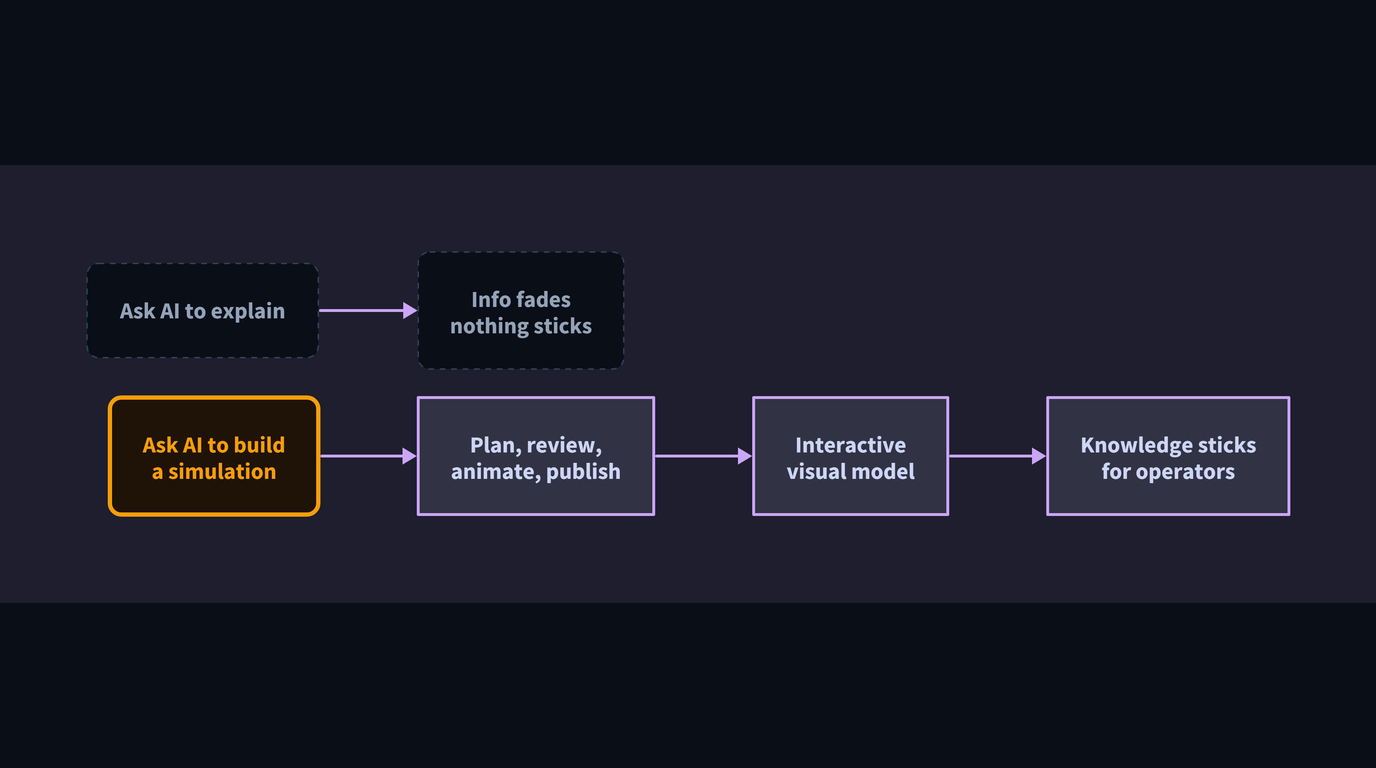
Most people use AI the same way they used Google. Type in a question. Read the answer. Close the tab. The information lands, sits for a moment, and then fades because nothing made it stick.
A software engineer named Laurentiu Raducu published a post this week describing a different approach entirely. He was not looking for a better prompt. He was looking for a better learning format, and what he built is worth understanding.
What happened
Raducu was researching AI-related bottlenecks in chip manufacturing for data centers. He ran into the same wall a lot of technically curious people hit: the topic is deep, the web is noisy, and asking an LLM to explain it produced what he described as responses that were “too simplistic” and, depending on the model, a little annoying.
So he changed the question entirely. Instead of asking the model to explain chip manufacturing, he asked it to build him a simulation of it.
The workflow he describes in his post has four steps. First, in plan mode using Claude Code or OpenCode, he asks the model to build a foundational knowledge base for the topic. Second, he asks the model to review the accuracy of what it just built. Third, he asks it to turn that knowledge into a low-poly, Rollercoaster Tycoon-style animation of the topic. Fourth, he adds UX requirements, like responsive design and playback controls, then pushes the result to a GitHub repo and publishes it with GitHub Pages.
The result is a project he calls ChipTycoon. You follow a cart from the moment sand is collected through every step until a finished chip reaches a data center. The cart changes visually as the product changes at each manufacturing stage. He has done the same thing for rocket engines, LLM architecture, F1 engines, and EUV machines.
His conclusion: the method works far better for retention than reading documentation or digesting a bulleted list. He also notes the output is “100% accurate and free of hallucinations,” which he attributes to the self-review step built into the workflow.
Why it matters for operators
This is not really a story about a cool side project. It is a story about a workflow pattern that solves a real operational problem.
Every organization has topics that are genuinely hard to train people on. A real estate brokerage trying to get agents up to speed on a new compliance framework. A SaaS company onboarding support staff on a technical product they have never touched. A logistics operation teaching new coordinators how freight routing actually works end to end. The standard answer has always been documentation, slide decks, or recorded walkthroughs. None of those formats are particularly good at making things stick.
What Raducu built is a template for converting dense, abstract knowledge into something you can watch and interact with. The model does the translation work. The human focuses on understanding the output, not on parsing raw text.
The self-review step matters here. He explicitly asks the model to check the accuracy of the knowledge base before building anything on top of it. That is a small procedural addition that changes the risk profile significantly. You are not just prompting and hoping. You are building in a verification pass.
What most people get wrong
Most people treat AI as a search engine with better sentences. They ask for explanations, get explanations, and measure success by whether the explanation sounded reasonable.
The problem is that comprehension and retention are different things. A good explanation can satisfy your brain in the moment without actually building durable understanding. This is why you can read a clear summary of how transformer models work, nod along, and then struggle to explain it to someone else an hour later.
Raducu’s workflow sidesteps this by changing the output format. Instead of generating text for you to read, the model generates a system you can observe and interact with. Your brain encodes it differently because you are watching cause and effect, not processing declarative sentences.
The broader mistake operators make is assuming AI-assisted learning means better content delivery. It can also mean better content format. Those are not the same thing, and the format question is almost always the one worth asking first.
The actual lesson
If you are trying to train your team on something genuinely complex, the prompt that matters is not “explain this topic.” It might be “build me something that shows how this works.”
The medium you learn through shapes what you retain. Raducu found a format that worked for him and built a repeatable workflow around it. That is the move worth copying, not the specific simulation.
For more operator-level reads on what AI workflows actually look like in practice, visit xovionlabs.com.