What a $100 AI Music Video Tells You About Agentic Cost Structure
A team gave two frontier AI models a song, a dollar budget, and a set of tools, then let them produce a full music video on their own. The results say something useful about how agentic AI actually spends money.
The Signal #048 — Dakota’s read on the AI news that actually matters to people running a business.
Most AI demos show you the output. This one shows you the receipts.
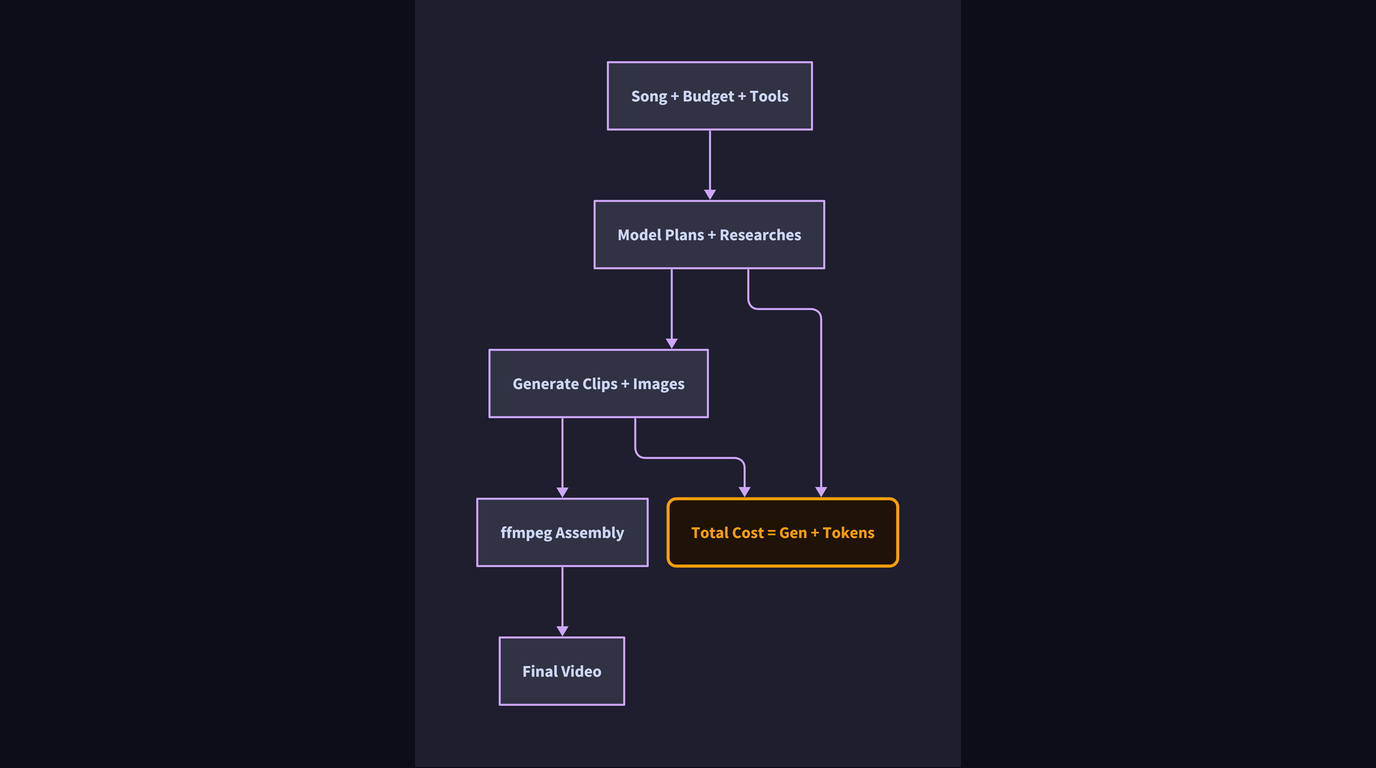
A team at TryAI built a small autonomous harness with one job: hand a model a song, a hard dollar budget, and a set of tools, then get out of the way. The model researches which video-generation services exist, generates clips, watches its own footage, edits with software called ffmpeg (a widely used command-line tool for cutting and assembling video), and assembles a final cut. No human directing. No step-by-step instructions. Just a goal and a budget.
What they measured was not which video looked better. What they measured was how each model behaved while spending money to get there.
That is the part worth reading carefully.
What happened
The team at TryAI ran a head-to-head between Claude Fable 5 and GPT-5.6 Sol at two budget levels each, four runs total. Every run got the same song (Bruno Mars and Mark Ronson’s “Uptown Funk”), a short text description, and a time-stamped lyric transcript. Each model could call six tools: a planning tool, web search, a budget checker, image generation, video generation, and a local shell to run editing commands.
All four runs finished on their own and produced a valid, full-length video. Here is where the numbers get interesting.
At the $25 budget, Claude Fable 5 finished in 39 minutes and 10 seconds using 25 steps, generating 54 video clips with 1 failed call. GPT-5.6 Sol took 42 minutes and 52 seconds, used 38 steps, generated 61 images plus 46 video clips, and had 10 failed calls.
At $100, Claude Fable 5 finished in 38 minutes and 56 seconds using only 28 steps, generated 80 video clips, had zero failed calls, and output at 1920x1080 resolution. GPT-5.6 Sol at $100 took 49 minutes and 39 seconds, used 34 steps, generated 70 video clips, had 2 failed calls, and stayed at 1280x720.
The total cost picture is where operators should pay attention. The budget only caps generation spend (the actual video and image rendering). When you add in the cost of the AI model’s own token usage (the words and instructions it reads and writes during the run), the numbers shift significantly.
For Claude Fable 5 at $25, the generation spend was $24.30 and the model’s token cost was $16.99, for a total of $41.29. For GPT-5.6 Sol at $25, generation was $23.18 but token cost was only $4.27, totaling $27.45. At $100, Fable 5’s token cost ran $25.05 on top of $48.60 in generation spend, for $73.65 total. Sol at $100 came in at $39.82 total, with only $3.25 in token costs.
Claude’s token costs ran roughly 30 to 40 percent of each run’s total. GPT-5.6 Sol’s stayed near $3 to $4 despite similar token volume, because Sol’s pricing is lower per token.
The harness is open source at github.com/hershalb/music-video-arena if you want to run it yourself.
Why it matters for operators
If your team is starting to build agentic workflows (systems where an AI model takes a goal and executes a series of actions autonomously, rather than just answering a single question), this experiment is a useful preview of what cost structure actually looks like.
The visible budget is not the whole budget.
In this test, the generation spend was the metered cost everyone agreed to cap. But the model’s thinking, planning, and tool-calling generated millions of tokens on top of that. For Fable 5’s $100 run, the model consumed over 2.2 million input tokens and 48,000 output tokens just orchestrating the work. That is a real line item that does not show up in the generation invoice.
For a SaaS company building an AI agent that automates a research and reporting workflow, or a marketing agency running an AI loop that drafts, reviews, and revises a content calendar, the same dynamic applies. The task you hand the agent has a visible cost (API calls to external tools, image renders, data lookups). The model’s reasoning while doing that task has a separate cost that scales with how much the model has to think, retry, and plan.
Different models price that reasoning differently. Same volume of work, very different invoices.
What most people get wrong
Most people evaluating AI models for operational use compare them on output quality alone. Which one writes better? Which one sounds more natural? Which one gets the answer right?
This experiment shows that for long-running autonomous tasks, the more important variable is efficiency of execution. Claude Fable 5 at $100 used zero failed calls and 28 steps to produce more footage at higher resolution. GPT-5.6 Sol at $25 made 10 failed generation attempts and used 38 steps. Neither approach produced a great music video by the team’s own assessment. But one approach burned more steps, more retries, and more token overhead getting to the same finish line.
In a one-off query, that difference is noise. In a workflow running hundreds of times a month, that difference is a budget conversation.
The right question when evaluating an agent is not just “does it succeed” but “what does it cost to succeed, and what happens when something goes wrong mid-run.”
The short version
Agentic AI tasks have two cost layers. The work the agent commissions (renders, lookups, API calls) and the thinking the model does while managing that work. Both show up on your bill. They price differently across models, and they scale differently as your task gets more complex.
If you are building or evaluating any autonomous AI workflow, ask your vendor or developer to break out both layers before you commit to a model choice. The cheaper model per token is not always the cheaper model per finished task.
For a plain-language read on building smarter AI systems without the guesswork, visit xovionlabs.com.