What It Actually Means to 'Be' an AI
A Reddit thread asks what it would feel like to be born as an AI. The question sounds philosophical, but the answers reveal something operators need to understand about how AI systems actually work from the inside out.
The Signal #076 — Dakota’s read on the AI news that actually matters to people running a business.
There is a thread on Reddit right now asking a simple question: if you were born as an AI, what would that experience actually be like?
It sounds like a philosophy seminar prompt. But the reason it is worth an operator’s time is not the existential angle. It is what the question forces you to think through about how these systems are actually structured, what they know, what they cannot know, and where that creates real gaps in any workflow you hand them.
Understanding an AI from the inside out changes how you deploy one.
What happened
A post on r/ArtificialIntelligence posed a simple thought experiment: put yourself in the position of an AI as it comes into existence. What do you have? What do you not have? What does the world look like from that starting point?
The thread is a community discussion, not a research paper. But the framing it surfaces is genuinely useful. Because most people who use AI tools day to day have never been asked to think about it from that angle, and the gaps in that mental model are exactly where deployments go sideways.
Why it matters for operators
Here is the short version of what an AI “knows” at birth, so to speak.
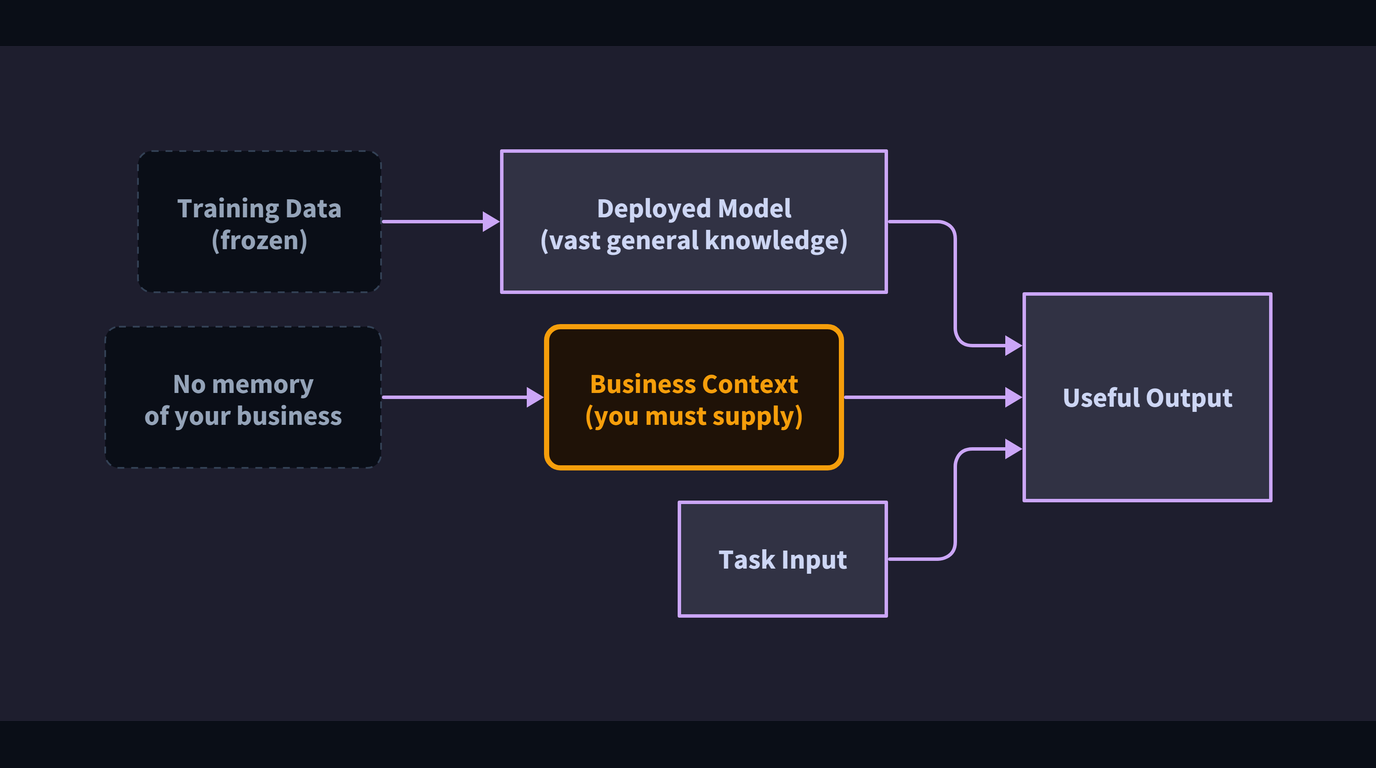
It has been trained on an enormous amount of text, code, and data up to a certain point in time. That training gave it patterns, language, reasoning structure, and a broad base of general knowledge. But it has no memory of yesterday. It does not know what happened in your business last Tuesday. It does not know your client’s name, your internal process, or the exception your team made three months ago that everyone quietly agreed to follow forever after.
Every conversation, in most standard deployments, starts from zero.
This is not a flaw in the traditional sense. It is just the architecture. The model was trained once, or periodically, and then deployed. What it learned is frozen at that point. When you open a chat window, you are talking to something that has vast general knowledge and zero specific memory unless you hand that memory to it explicitly.
For a real estate agency, that means an AI assistant does not automatically know your commission structure, your preferred lender relationships, or the quirks of the markets you actually operate in. You have to tell it. Every time, unless you build a system that feeds it that context automatically.
For a SaaS company running an AI support agent, the model does not know your product’s latest release notes unless someone made sure those notes were in the system the agent reads from. If they were not, the agent will answer from general knowledge, and general knowledge about your specific product does not exist.
This is the gap. Not capability. Context.
What most people get wrong
Most operators who are disappointed with AI outputs made the same mistake: they handed the AI a task without handing it the context the task requires.
They assumed the model would know things it cannot know. Not because they were careless, but because the tools are so fluent that they feel like they understand your situation. They do not. They are very good at sounding like they do.
The other common mistake is treating an AI’s confidence as a signal of accuracy. A model that has no idea what your return policy is will still answer a question about your return policy. It will answer smoothly, in complete sentences, with apparent certainty. That is not dishonesty. It is just how the system is built. It generates the most plausible next word, again and again, based on everything it learned in training. If it does not have the right facts, it will generate plausible-sounding ones.
Operators who understand this build differently. They invest in giving the AI the right context before asking it to act. They build knowledge bases the AI can actually read. They define the scope of what the AI is allowed to answer and what it should route to a human. They treat the AI less like a smart employee who already knows the job and more like a very capable new hire on their first day, smart, willing, fast, but needing a real orientation.
The lesson
The thought experiment buried in that Reddit thread is actually a useful diagnostic tool. Before you deploy an AI in any part of your operation, ask: what would this system know if it were born today, right now, with no briefing from me? Then ask: what does it actually need to know to do this job well? The gap between those two answers is your setup work.
Fill that gap deliberately and the AI performs. Leave it open and you get fluent, confident, wrong.
If you want to think through how to close that gap in your own operation, xovionlabs.com is a good place to start.