The Signal
AI
Anthropic Is Blocking Users Who Touch AI Training Workflows. Here Is What That Tells Operators.
Anthropic is restricting or terminating sessions for paying users whose prompts touch topics like model training and fine-tuning. Here is what the incident actually signals for any operator building workflows on top of AI APIs.
The Signal #123 — Dakota’s read on the AI news that actually matters to people running a business.
When a paying customer gets cut off mid-session for asking the wrong kind of question, that is not a customer service story. It is an infrastructure story.
A post from Jiahao Shao, a CS PhD student at HKUST, went viral on October 31st with 304,100 views. He described being blocked by Anthropic’s systems after his usage was flagged as related to training a competitor model. His account of what happened is worth reading carefully, because the implications go well past one researcher’s frustration.
What happened
In his post on X, Shao describes using Claude to help submit jobs and run analysis as part of a research workflow. The rollouts in his pipeline came from a strong open-source model, not from Claude outputs directly. He says he never distilled Claude (distillation being a technique where you use a large model’s outputs to train a smaller or different model, essentially teaching one model by example from another).
Despite that, his account was flagged for what Anthropic categorized as training a competitor. After that flag, he says anything he prompted that touched RFT (reinforcement fine-tuning, a method for teaching models to improve through reward signals), SFT (supervised fine-tuning, a method for teaching models on labeled examples), or training larger models in general would result in one of three things: being blocked outright, having his model tier downgraded from Opus 5.5 to Opus 5, or having the session killed entirely.
He also raised a broader point in a follow-up post: Anthropic’s models were trained on the open web, including books, code, and forums produced by others, but the platform restricts users from learning from Claude’s outputs at scale.
Anthropic has not issued a public statement addressing Shao’s specific account.
Why it matters
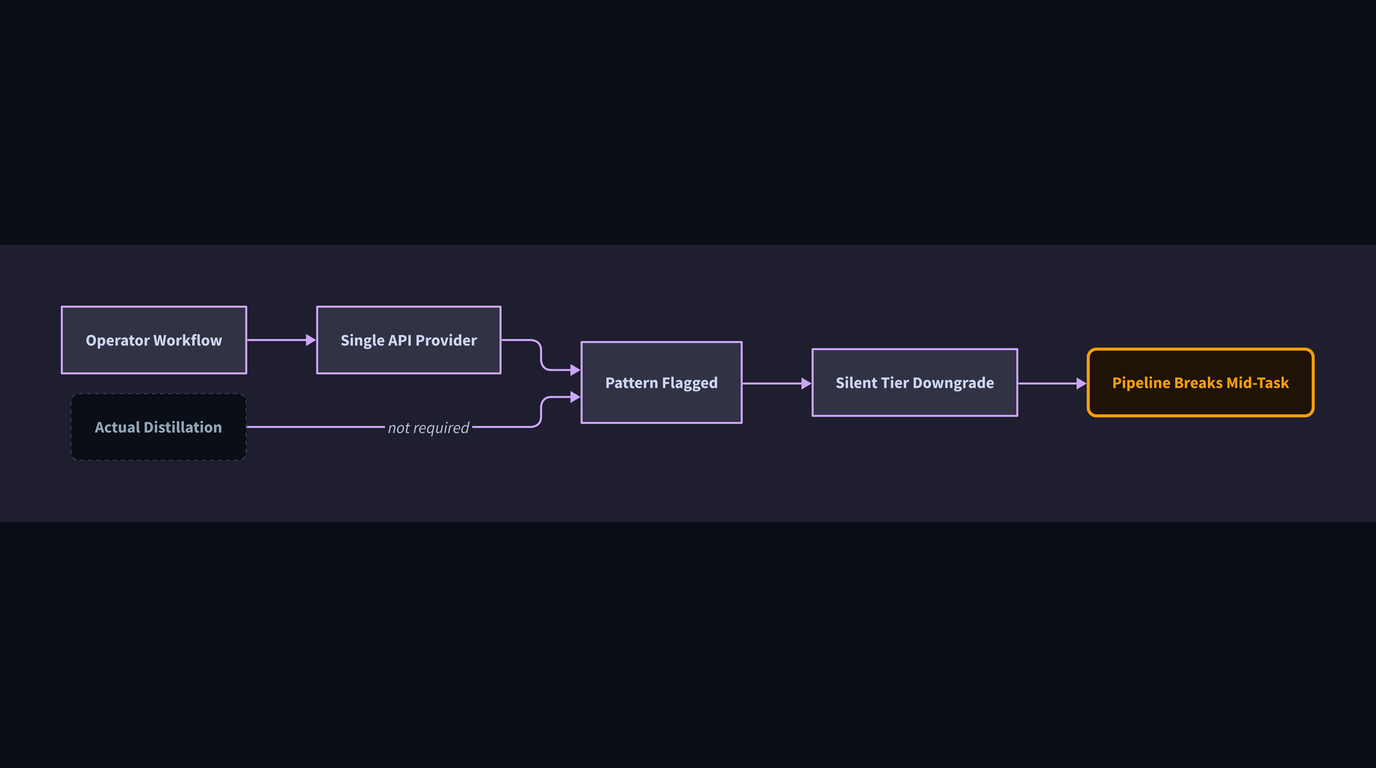
This is not primarily a story about distillation rules or AI ethics debates. It is a story about what happens when your operational workflow depends entirely on a single external API provider.
Think about a SaaS company that built an internal tooling pipeline where an AI model helps engineers triage bugs, draft documentation, and categorize support tickets. Or a real estate agency using an AI assistant to process listing data and draft offer summaries at volume. These are normal, legitimate workflows. But if any prompt inside those workflows starts to resemble a pattern the provider has flagged, even without the operator intending anything the platform prohibits, the session can be degraded or terminated mid-task.
Shao describes a specific behavior: the model tier being downgraded within a session, not just a hard block. That means the service change can happen silently, without a clear error message, while work is still in progress. An operator may not know the response quality dropped until something downstream breaks or the output quality shifts in ways that are hard to trace.
For anyone running automated pipelines at volume, that kind of silent degradation is harder to manage than an outright failure. A failure throws an error. A quiet downgrade just produces worse results.
What most people get wrong
The reflex reaction to a story like this is to debate whether Anthropic’s policy is fair. That debate will continue. But for an operator, the more useful question is: what does it mean that this is even possible?
Usage policies for AI APIs are enforced by automated pattern-matching systems, not by humans reading each conversation. Those systems are built to catch bad actors, but they operate on signals, not intent. If your workflow produces signals that resemble a prohibited pattern, the system reacts to the signal. It does not know your intent.
This is true of Anthropic, and it is true of every major AI API provider. All of them have acceptable use policies. All of them have automated enforcement. None of them guarantee that a legitimate workflow will never trip a filter.
The mistake is treating API access as infrastructure on the same level as compute or storage. It is not. It is a service with terms that can change, enforcement systems that can misfire, and no obligation to explain a block before it happens.
The lesson
If your business depends on AI outputs, the resilience question is not just whether the model is capable enough. It is what happens when access changes without warning.
Operators building on AI APIs should know what their fallback is, whether that is a secondary provider, a local model option, or a process that can run without AI temporarily. Not because Anthropic or any other provider is acting in bad faith. But because any single point of dependency is a risk, and automated policy enforcement is not precise.
Shao’s situation is one data point. It will not be the last one.
If you want to think through how to build AI workflows that account for this kind of risk, xovionlabs.com is a good place to start.
The Signal
Read next.
AI · AI Governance
Goldman Sachs Just Pulled AI Coding Tools From Its Traders and Bankers. Here Is What That Decision Actually Tells Operators.
Goldman Sachs restricted Anthropic's Claude Code and Microsoft's GitHub to engineers only, cutting off traders and bankers who had been building their own tools. Here is what the reasoning behind that call means for any operator thinking about who gets access to AI agents.
AI · AI Strategy
Microsoft Just Shut Down Its Internal AI Research Group. Here Is What That Decision Reveals.
Microsoft's AI Frontiers group, a roughly 50-person research team inside Microsoft Research, was dissolved in early September after being folded into a larger organization with a fundamentally different philosophy. Here is what that internal decision tells operators about how the biggest players in AI are actually thinking right now.