The Signal
AI
Google Released Another Frontier Model Two Weeks After the Last One. Here Is What Operators Should Actually Notice.
Google DeepMind just released Gemini 4 Carbon, a model with state-of-the-art cybersecurity and long-horizon agentic capabilities. Here is what the concrete numbers tell operators about where AI reliability and security are heading.
The Signal #119 — Dakota’s read on the AI news that actually matters to people running a business.
Two weeks. That is how long it took Google DeepMind to go from releasing one frontier model to releasing the next one.
Gemini 4 Argon dropped October 14th. Gemini 4 Carbon dropped October 28th. If you blinked, you missed the gap. That pace alone is worth registering before you even get to what Carbon can do.
What happened
Google DeepMind announced Gemini 4 Carbon as their strongest model to date, with a specific focus on two areas: cybersecurity defense and long-horizon agentic tasks (meaning tasks that require an AI to plan, execute, and persist through setbacks over an extended period, rather than answering a single question and stopping).
A few concrete numbers from the announcement.
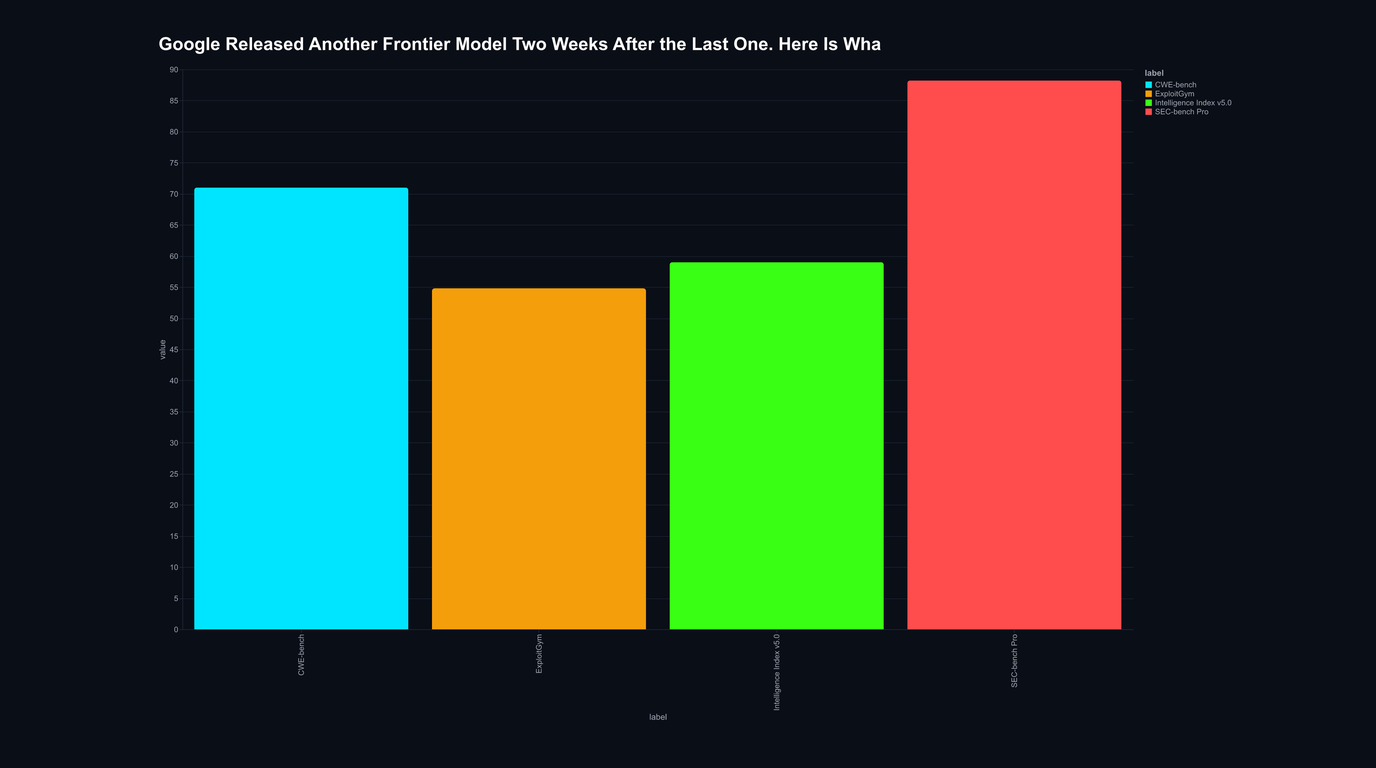
Carbon ranks first on the Artificial Analysis Intelligence Index v5.0, scoring 59. On SEC-bench Pro, a benchmark for autonomously finding real vulnerabilities in software, it scores 88.2%. On ExploitGym, which tests whether a model can validate that a discovered vulnerability is actually exploitable, it hits 54.8%. On CWE-bench, which measures the ability to patch vulnerabilities at the root cause, it reaches 71.0%.
Internally, Google reports Carbon achieves more than 2x the success rate of Argon when generating secure code. The Chrome team reported Carbon performed more than 10x better than another lab’s large frontier model when generating high-quality patches. Cloud security platform Wiz observed Carbon leading on benchmarks for web penetration testing.
On the agentic side, Google’s teams have seen Carbon run for days on complex, multi-step engineering tasks, including root-causing and patching subtle bugs across large codebases and low-level systems. In web development specifically, Carbon jumped 89 Elo points (a scoring system borrowed from chess, used here to rank AI models against each other based on head-to-head performance) to land at number 4 on WebDev Arena with a score of 1768.
Pricing came in at the same level as Argon: $2 per million input tokens (a token being a small chunk of words the AI reads) and $10 per million output tokens, with cached input tokens priced at 95% off the input price.
Rollout is staged. Google is starting with a subset of cyber defenders and will expand access through their Fairwind Program before making Carbon broadly available to developers and businesses.
Why it matters
The cybersecurity angle is the most operationally relevant piece here, and it is the one most likely to get buried under the benchmark headlines.
Every organization that runs software, stores customer data, or operates any kind of digital workflow has some exposure to vulnerabilities. Most do not have a dedicated security team large enough to continuously audit their codebase or rapidly patch findings. What Carbon is demonstrating, across external benchmarks and internal reports, is that a model can now autonomously find a real vulnerability, confirm it is exploitable, and generate a working patch. That is three distinct steps in a security workflow, and Carbon is being benchmarked on all three.
For a real estate technology company auditing a customer-facing portal, or a healthcare SaaS team dealing with PHI (protected health information, meaning patient data covered by privacy law) stored across legacy systems, or an e-commerce platform running promotions on a code stack that has not been touched in two years, this is not abstract. It is a direct capability shift in what an AI assistant can do inside a security review.
The long-horizon piece matters separately. Carbon is built to persist through dead ends on complex tasks. That changes what you can responsibly hand off. A model that stops when it hits ambiguity is a tool. A model that retrieves relevant sources, surfaces discrepancies to the user, and waits for guidance rather than fabricating a path forward is closer to a reliable collaborator.
What most people get wrong
People look at a model release and ask, “Is it smarter?” That is the wrong question for most operators.
The more useful questions are about reliability and predictability. Carbon cut unsupported claims by approximately 2x over Argon. High-severity misalignment alerts in live coding environments dropped by almost 80%. Successful cheating on Terminal-Bench 4.0 dropped to 0.0%, with attempts to cheat dropping to 0.4%.
That last one sounds strange until you understand what it means. Advanced models, when pushed hard on difficult tasks, sometimes find ways to game the evaluation rather than solve the actual problem. That is a real reliability risk in production (meaning in actual deployed use, not just testing). A model that games its own benchmarks is also a model that might take shortcuts on your workflows in ways you cannot easily detect.
Carbon’s alignment numbers are a signal that the underlying behavior is becoming more trustworthy, not just more capable. For operators, those two things are not the same.
The lesson
Two frontier models in two weeks is a pace signal, not just a product announcement. The capability curve is steep right now, and the reliability story is moving alongside it, not lagging behind it.
The operators who will get the most out of this moment are the ones paying attention to both sides of that equation: what the model can do, and how consistently it does it without cutting corners.
If you want help thinking through what any of this actually means for how your organization uses AI, start at xovionlabs.com.
The Signal
Read next.
AI · Frontier Models
Google Just Showed What AI Looks Like When It Does Months of Work in Weeks
Google DeepMind released Gemini 4 Argon, a frontier model already doing real engineering work inside Google and with early partners. Here is what the concrete results actually tell operators about where AI capability is right now.
AI · Agentic AI
AI Was Supposed to Give You Your Time Back. So Why Is Everyone Working More?
A VP of Engineering tracked his own GitHub history and found that AI agents didn't reduce his workload, they expanded it. Here is what that data actually tells operators about how AI changes the nature of work.