The Signal
AI
Kromoss Is Out: What a New Open Image Model Tells Operators About the Speed of This Space
Kromoss, a new open image generation model, just dropped in the Stable Diffusion community. Here is what the release pattern tells operators about how fast open AI tooling is moving and what that means for anyone building with it.
The Signal #113 — Dakota’s read on the AI news that actually matters to people running a business.
New open-source image models are dropping faster than most operators can track them. Kromoss is the latest one drawing attention in the Stable Diffusion community, and the conversation around it is worth a few minutes of your time, even if you have never touched an image generation tool in your life.
The reason is not the model itself. The reason is what this release pattern keeps telling us about the pace of the space.
What happened
The Stable Diffusion community on Reddit posted about the release of Kromoss, flagging it as a new open model available for download and use. The post drew immediate engagement from practitioners in the image generation community who work with these models directly, running them locally or integrating them into workflows.
The Stable Diffusion ecosystem is a segment of the broader AI space where open-weight models (models whose internal parameters are publicly released so anyone can download, run, or modify them) get shared, tested, and iterated on rapidly. Kromoss appears to be one of those releases, a model contributed to the open community rather than gated behind an API or a paid product.
That is the extent of what the source tells us. No benchmark numbers, no company behind it, no technical spec sheet. Just a community noticing it arrived and starting to work with it.
Why it matters
If you are running a real estate agency, an e-commerce operation, a marketing firm, or any business that produces visual content, the image generation category is probably already on your radar in some form. Tools built on open models power a significant portion of the AI image products that exist today.
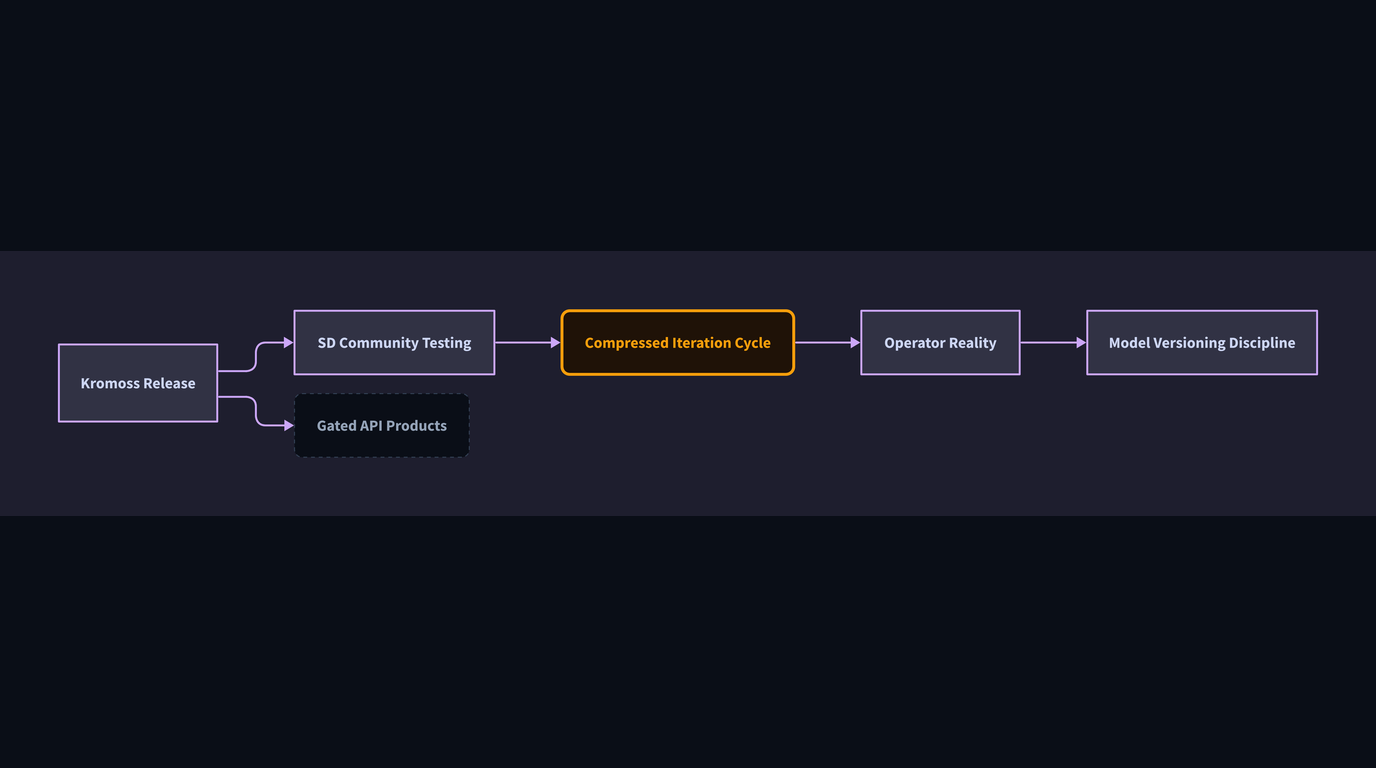
Here is the operational point worth sitting with. The open model ecosystem does not move on product release schedules. It moves on community momentum. A model drops, practitioners test it within hours, feedback surfaces within days, and the next iteration starts. That cycle is compressed compared to anything a traditional software vendor would ship.
For operators, this creates two practical realities. First, the tooling you are evaluating today may already be behind what practitioners are running. The gap between what is available and what is in a polished product interface is often months wide. Second, if you are building anything, whether that is an internal content pipeline, a client-facing product, or an automated creative workflow, you are likely building on top of a foundation that will shift under you. That is not a warning to avoid the category. It is a reason to understand how the foundation works, not just the product sitting on top of it.
A SaaS company adding AI image features to their product, for example, needs to think about model versioning the same way they think about dependency management in their codebase. When the underlying model changes, outputs change. That has downstream effects on quality control, user expectations, and any automated pipelines that depend on consistent results.
What most people get wrong
Most operators who are new to this space treat open model releases as noise. Something dropped on Reddit, enthusiasts are excited, move on. That instinct is understandable, but it misses something.
The open ecosystem is where capability shows up first. The polished commercial tools almost always arrive after the community has already validated what works. Practitioners in spaces like Stable Diffusion are running experiments that will inform what shows up in the products you buy six to twelve months from now.
The mistake is treating that community as separate from your business. It is not. It is your early warning system. Watching what gets traction in open model communities, even without diving into the technical details, gives operators a read on what directions capability is heading before vendors put a price tag on it.
The other common mistake is assuming open means unreliable. Open-weight models run in production at serious scale across agencies, e-commerce platforms, and software products. The word open describes the licensing and distribution, not the quality ceiling.
The actual lesson
Kromoss may or may not turn out to be significant. The source does not give us enough to know. What it does give us is another data point in a consistent pattern: the pace of open model releases is not slowing down, the community testing them is large and technically capable, and the distance between a Reddit post and a production-ready workflow is shorter than most operators assume.
You do not need to download every model that drops. You do need to understand that the ground is moving, and that staying informed is an operational decision, not just a technical curiosity.
If you want a clearer picture of how to think about AI tooling for your specific operation, start at xovionlabs.com.
The Signal
Read next.
AI · AI Governance
Goldman Sachs Just Pulled AI Coding Tools From Its Traders and Bankers. Here Is What That Decision Actually Tells Operators.
Goldman Sachs restricted Anthropic's Claude Code and Microsoft's GitHub to engineers only, cutting off traders and bankers who had been building their own tools. Here is what the reasoning behind that call means for any operator thinking about who gets access to AI agents.
AI · AI Strategy
Microsoft Just Shut Down Its Internal AI Research Group. Here Is What That Decision Reveals.
Microsoft's AI Frontiers group, a roughly 50-person research team inside Microsoft Research, was dissolved in early September after being folded into a larger organization with a fundamentally different philosophy. Here is what that internal decision tells operators about how the biggest players in AI are actually thinking right now.