Insights
AI
Giving an agent search does not give it evidence
Cloudflare’s Web Search API makes retrieval easier to wire in. A useful research workflow still needs claim-level sources, dates, and an honest unresolved state.
Ask an agent a current question and a search connection feels like the missing piece. Now it can find the latest information.
But finding a relevant page and supporting a specific claim are separate jobs. A search result can point toward the answer without containing the qualification that changes the decision.
Give the agent a way to search, then require an evidence record for the claims that matter. The record should make it possible to inspect why the answer is supported.
What changed
On October 2, Cloudflare announced Web Search API through AI Gateway, starting with Ceramic.ai, Exa, and Linkup. Its announcement describes REST and Workers integration paths, with search results that include source links.
It separately describes native server tools inside AI Gateway as coming soon. That distinction prevents a common planning error: treating every capability mentioned in an announcement as already available.
The feature is a retrieval option. This article does not claim to have benchmarked it or that it verifies an agent’s conclusions automatically.
Decide which question the source must answer
Take a hypothetical purchasing question: “Can this supplier deliver the required component before our installation date?”
Search might find a product page that says “in stock.” That is useful discovery. It does not answer whether the required variant is stocked, whether the quantity is available, or when it can arrive at the project.
Break the decision into claims: the product matches the specification; the required quantity is available; the quoted delivery date meets the deadline.
For each claim, record the actual source and the scope of what it supports. A general product page might support the specification. An order-specific supplier confirmation might be needed for delivery.
The distinction keeps an agent from stretching a true sentence into an unsupported promise.
Put a small evidence record beside the answer
A workable record contains the claim, source URL or document identifier, source date when available, retrieval time, and the passage or data that supports the claim.
Then add a status: supported, contradicted, or unresolved. Do not silently treat an inaccessible page as an empty result or a positive confirmation.
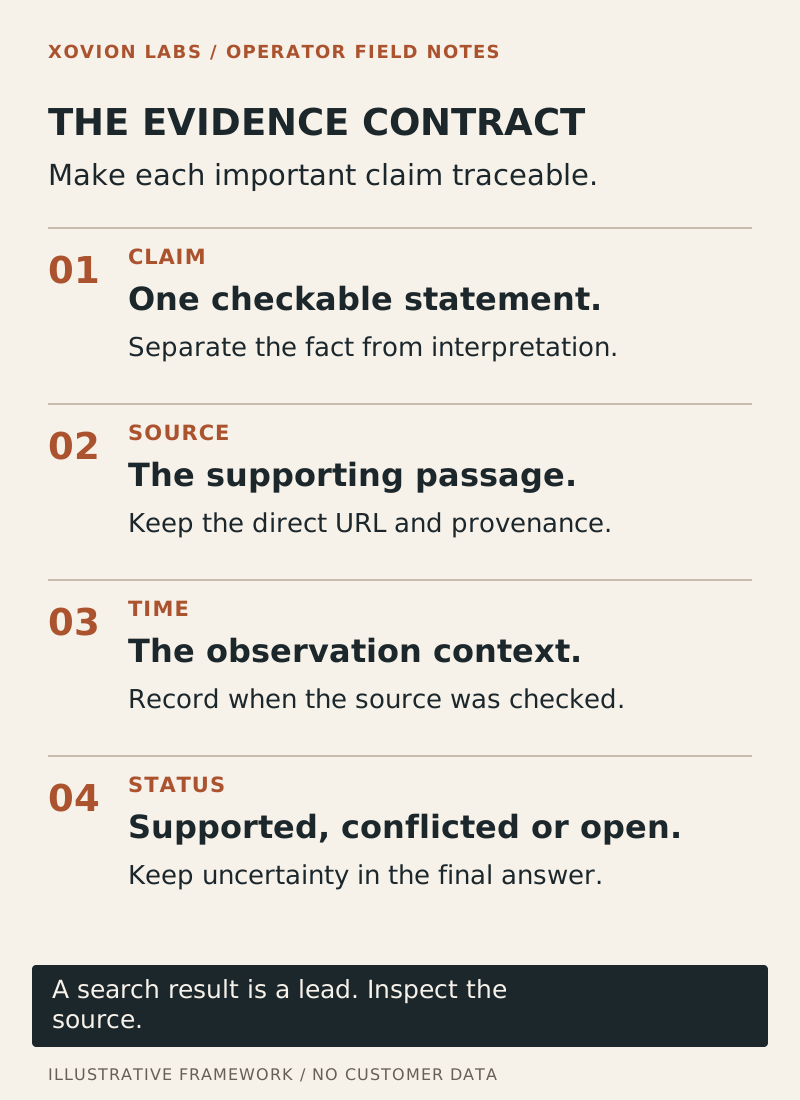
This does not require citations after every harmless sentence. Prioritize facts that change the decision: availability, amounts, dates, permissions, and product behavior.
Separate source evidence from your interpretation. “The announcement says access is limited to a preview” is a source claim. “That makes it unsuitable for our next production release” is a decision based on your requirements.
Test the contract with five questions
Choose five questions your team already knows how to verify. Include a clear answer, an outdated page, a future announcement, two conflicting sources, and a source that cannot be opened.
Use public or sanitized examples. Run the questions through your proposed research workflow and inspect the records.
Measure how many material claims have usable evidence, how many source limitations remain visible, and whether any unsupported claim is presented as settled. Record retrieval failures separately from “nothing relevant found.”
A useful success test is that another person can follow each material claim back to the source and reach the same narrow conclusion. Where they cannot, revise the claim or leave it unresolved.
This is a proposed evaluation, not a guarantee that five questions establish production readiness.
Search is only one input path
Some answers belong in an authenticated business system, an executed agreement, or a direct confirmation. Public web search cannot substitute for access to those records.
Likewise, a current retrieval time does not make an old document current. Preserve both when possible. The page may have been fetched today while describing a policy that changed last month.
When the question is order-specific, the most useful answer may be: “The public page establishes the specification. Delivery for this order still needs confirmation.”
Make the answer inspectable
The next step is to add one field to an existing agent output: “What supports this claim?”
If the answer is just a list of links, tighten it until the reader can tell which source supports which conclusion. That is the bridge from search access to useful evidence.
For the underlying source-to-record pattern, continue with From Messy Data to Trusted Data.
Source and scope
Cloudflare: Introducing Web Search API via AI Gateway, October 2, 2026. Availability is described as announced; account eligibility should be checked directly. The purchasing scenario and evaluation are illustrative. No supplier claim or Xovion product benchmark is asserted.