Insights
AI
Stop your AI search from quoting retired instructions
A source link can point to a real procedure that no longer applies. Test current answers, historical answers, and the transition between them.

The assistant answers immediately and includes a source link. The instructions are clear, detailed, and wrong for the way the business operates now.
It found the procedure you retired last month.
An answer can be grounded in a real document and still direct the team to obsolete work. Internal search needs a way to distinguish retained history from current authority.
Finding more material raises the maintenance question
Cloudflare’s October 1 AI Search announcement describes a managed indexing and retrieval pipeline reaching general availability, with expanded support for images and scanned PDFs.
That is useful for organizations whose knowledge lives in mixed formats. It also makes the contents of the indexed collection more consequential. Better retrieval does not decide whether an old document is still allowed to instruct today’s team.
This is a collection-management problem to test in your implementation, not a claim that Cloudflare’s product necessarily returns obsolete documents.
Preserve history without letting it give orders
Imagine a hypothetical service desk changing how urgent requests are escalated. The old procedure names one inbox. The new procedure routes them to a staffed queue.
Both documents may need to remain available. Someone investigating a past incident needs to know the rule that applied then. Someone handling a request today needs the current rule.
Deleting every old file loses useful history. Putting every file into one undifferentiated search collection makes it harder to preserve the distinction.
Define the role of each document before indexing it:
| Document role | Intended use |
|---|---|
| Current approved procedure | Answer questions about today’s operating rule |
| Proposed revision | Support review without directing live work |
| Superseded procedure | Explain a historical period, with its status visible |
| Reference material | Supply context without automatically becoming policy |
Keep a stable identifier, owner, revision, effective date, and status where the retrieval system can use them. A filename containing “old” is helpful to a human browsing a folder, but do not assume it becomes an enforceable retrieval rule.
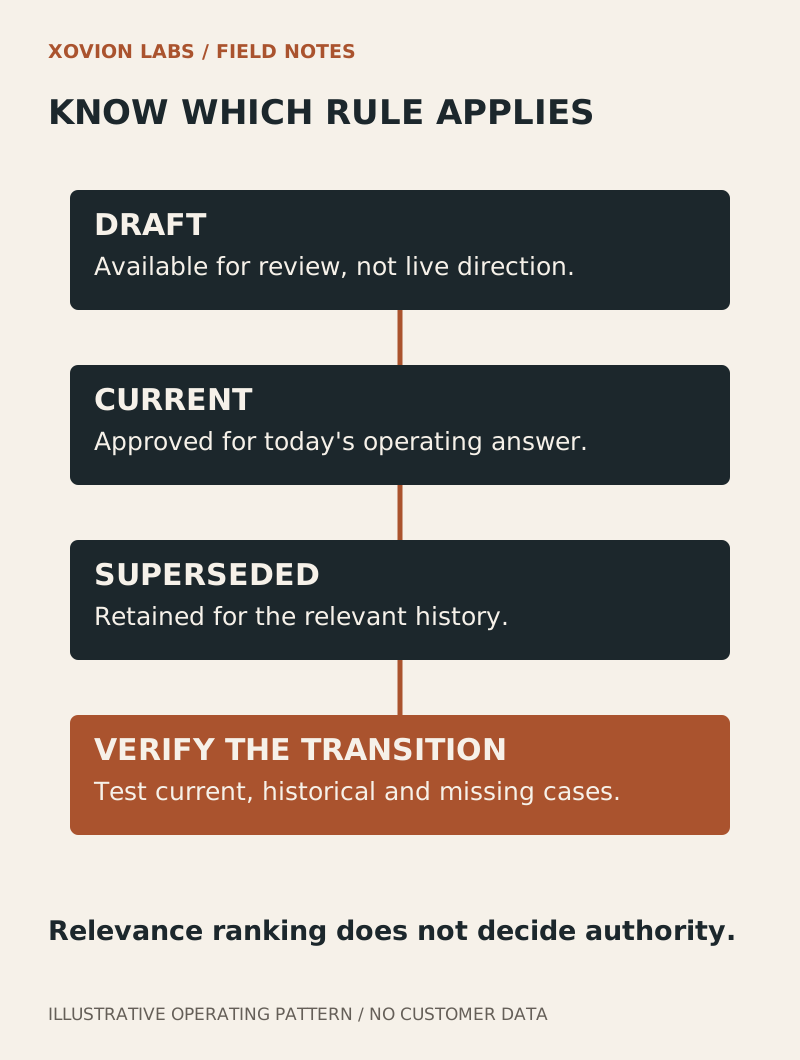
Test the transition, not just the first upload
A search demonstration usually starts with a fresh collection. Real operating knowledge changes after that demonstration.
Use synthetic procedures for a small lifecycle test. Create an initial approved rule and ask a known question. Publish a replacement with a deliberately different answer, mark the first version superseded, and run the ordinary update or indexing process.
Now ask two questions: “What should the team do today?” and “What was the rule before the change?” The expected answers should differ and cite the correct revisions.
Inspect the retrieved passages as well as the final prose. A model might produce the right answer while receiving conflicting sources, leaving a fragile result that changes on the next run.
If the system caches retrieval results or generated answers, include those layers in the test. Do not assume changing the source document instantly changes every answer. Record what was updated and when the new behavior became observable.
Plan for the incomplete update
What should happen if the old rule is marked retired but its replacement has not finished indexing? Decide that before allowing the assistant to advise on consequential work.
A useful response may be “the current procedure is temporarily unavailable,” with a route to the responsible person. Silently falling back to the retired rule can conceal a maintenance failure as a helpful answer.
Likewise, when two approved documents appear to conflict, preserve the conflict and request resolution. Do not make relevance ranking the authority that settles company policy.
Add retirement to the publishing checklist
For the next procedure change, identify the document being replaced and include the search update in the release work. Verify the new answer, the historical answer, and the missing-replacement case.
For keeping the authoring source aligned with the installed instructions, read Your AI playbook needs one current version. Retrieval adds another boundary: the system must know which retained version is allowed to answer which question.
Source and scope
Cloudflare: AI Search general availability, October 1, 2026. Indexing and format capabilities are vendor-described. The escalation example, document roles, and lifecycle tests are illustrative recommendations. No product-specific deletion, synchronization, or cache-invalidation guarantee is asserted.