The Signal
The Signal
Cloudflare gives coding agents their own repos. Who decides what ships?
Artifacts now lets teams fork agent work and wire previews to review. Isolation helps, but the acceptance decision needs evidence and an owner.
The Signal · Agent infrastructure · October 5, 2026
Give two coding agents the same bug and they may return two plausible fixes. A separate workspace for each agent prevents them from overwriting one another. It does not tell you which fix is safe to ship.
On October 1, Cloudflare moved Artifacts into open beta. Artifacts is a versioned filesystem that speaks Git. Cloudflare had launched the underlying service earlier in 2026; this announcement adds a clearer route from programmable repositories to builds, previews, event-driven review, and deployment. The new pieces make parallel agent work easier to organize. They also make the release boundary more consequential.
What actually changed
An Artifacts repository can be created or forked in code. A Worker binding can inspect files and commits and issue a repository-scoped Git token. That means an orchestration service could hand each task its own fork and credentials instead of letting several agents alter one shared working tree.
Cloudflare now connects those repositories to Workers Builds. A push to a nonproduction branch creates or updates an isolated Worker preview. A push to the configured production branch builds and deploys the Worker. Repository events can also start CI or a code-review workflow. Cloudflare added U.S. and EU jurisdiction choices for repository namespaces and per-repository operation and error metrics. These are Cloudflare’s described product capabilities, not a Xovion deployment or an independent test of their reliability.
For an operator, the distinction matters: preview means a place to inspect a candidate. Production branch means a path to a live change. If an agent can push to that branch, the branch name alone is not an approval process.
Isolation buys room to compare
Separate repositories let agents explore different approaches from the same starting point. The work can retain its own code, tests, and context. A reviewer can inspect each result without first untangling two agents’ edits in one directory.
That is useful when the problem has several reasonable solutions, or when one agent is investigating a failure while another is implementing a narrower change. It may also help a team discard a poor attempt cleanly. None of this establishes that the changes are correct, and Cloudflare has not published an independent measure of reviewer time saved for a typical small-business workflow.
The harder question moves downstream: what requirement did each agent assume, what behavior changed, and what evidence distinguishes a genuinely safe fix from a polished explanation?
A hypothetical follow-up bug
Imagine a service company whose booking system schedules a follow-up text for leads who have not booked. A customer books an appointment just before the scheduled text goes out. The message still sends, making the business look inattentive.
Agent A proposes checking the booking state immediately before sending. Agent B proposes canceling pending follow-ups whenever an appointment appears. Both approaches might work in a simple demonstration. The real cases are less tidy: an appointment may arrive from a second system, the cancellation event may be delayed, and a text already handed to the provider may no longer be retractable.
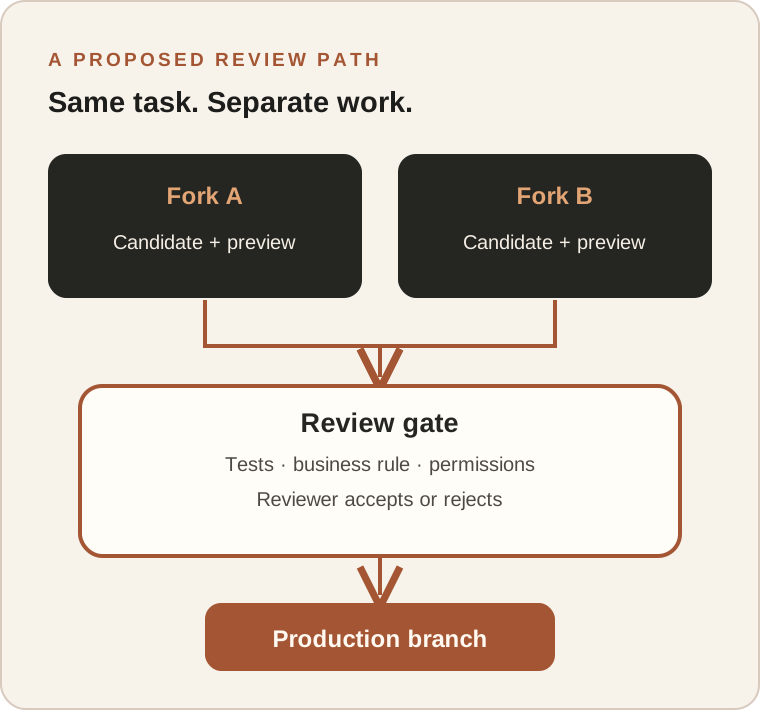
Give each agent a fork. Ask for a preview and a test that exercises the order of events, including a late booking and a delayed update. Then have someone who owns the customer workflow decide the intended rule: should a booked customer receive no follow-up under every circumstance, and what should the team see when the booking source is unavailable? The scenario and proposed tests are hypothetical; they are not Xovion results.
The fork keeps the attempts separate. The operator’s rule and the evidence determine which, if either, should be accepted.
A small pilot before changing the workflow
If you already use coding agents, choose one bounded, noncritical issue in a staging environment. Give two agents identical acceptance criteria and separate forks. Require each to submit a change summary, the exact behavior it changes, tests for the risky case, and a preview. Have one reviewer log the minutes needed to understand, test, and approve or reject each result.
Check the mechanics too. Can a task token reach another repository? Does a push trigger the expected review job without making duplicate work? Can you identify who or what pushed the production branch? Can you stop a pending deployment and return to a known version? These are questions for your own configuration, not guarantees supplied by the announcement.
Compare total time to an accepted change, including rework and review. If the agents produce more candidates than the team can assess, adding repositories has increased the queue rather than improved delivery. If your present Git workflow already isolates tasks and gives reviewers good evidence, waiting may be entirely reasonable.
The cost and the boundary
Artifacts is available in open beta on the Workers Paid plan. Cloudflare says billing for Artifacts usage begins October 15, 2026, based on operations and stored data. That is an announced billing start, not a measured cost for your workload. Preview and review activity can add other operational costs and maintenance even when repository operations look inexpensive.
The operator takeaway: use programmable forks when parallel work is actually causing collisions or lost context. Keep the production path protected by an accountable review that checks behavior, permissions, and recovery. Cloudflare has made it easier to create candidate workspaces. Your business still has to decide what counts as proof.
Related: Code review needs behavioral proof and read, decide, act permissions.
Primary source: Cloudflare’s October 1 Artifacts announcement, checked October 5. Product capabilities and availability are vendor statements; the booking example and pilot are proposed, not reported Xovion tests.
The Signal
Read next.
Risk · Security
Your agent needs three permissions: read, decide, and act
Persistent agents make permission design an operating decision. Separate access to information from authority to change the business.
Agents · Automation
Dots can keep working. Give them a job that has an end condition.
OpenAI’s always-on agents shift the question from prompting to delegation. Start with a bounded responsibility, visible evidence, and a clear handoff.