The Signal
AI
NVIDIA Just Released a 74-Billion-Parameter Model That Runs Like a Much Smaller One
NVIDIA's Nemotron Bolt 3.5 74B A9B is a large language model designed to run efficiently on hardware that would normally struggle with a model this size. Here is what operators need to understand about what that actually means.
The Signal #107 — Dakota’s read on the AI news that actually matters to people running a business.
A 74-billion-parameter model that behaves like a much leaner one. That is the headline behind NVIDIA’s Nemotron Bolt 3.5 74B A9B, which released October 15th.
If that string of numbers and letters feels like noise, give it sixty seconds. There is a real operational concept buried in here worth understanding.
What happened
NVIDIA released Nemotron Bolt 3.5 74B A9B on October 15th. The model is being discussed in the local AI community because of what its name signals about its architecture.
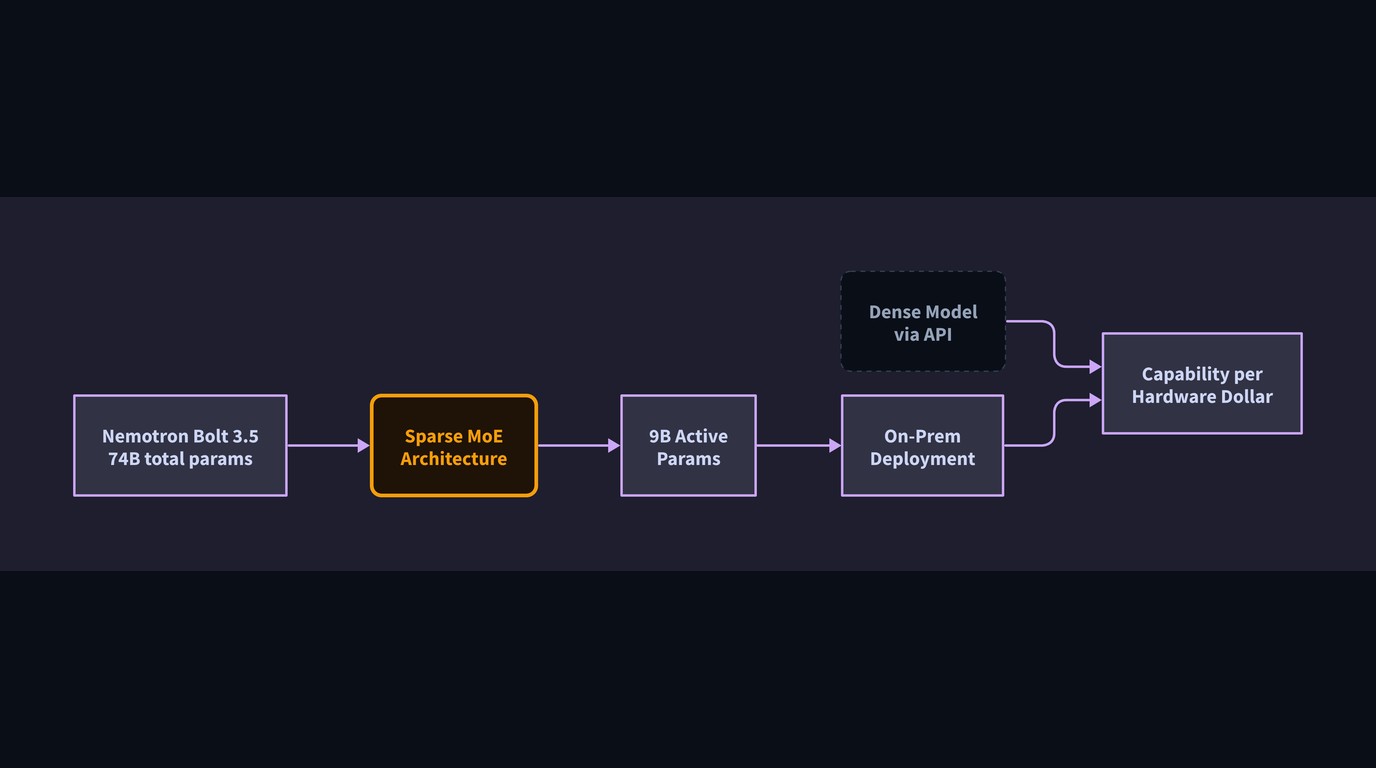
Breaking down the label helps. “74B” means 74 billion parameters (parameters being the internal numerical values the model learned during training, which determine how it responds to any given input). “A9B” means only about 9 billion of those parameters are active at any one time when the model is actually running.
This is a design pattern called a sparse or mixture-of-experts architecture (a setup where the model is divided into specialized sub-sections, and only the relevant sub-sections activate for a given task, rather than the whole model firing at once). The practical result is that a model with 74 billion total parameters can run with the memory and compute footprint closer to a 9-billion-parameter model, while still having access to the knowledge and capacity of the larger one.
The model comes from NVIDIA’s Nemotron line, which is positioned as a series of models optimized for deployment on NVIDIA hardware, including setups that operators might actually own or rent rather than just access through an API (an API being a connection point where you send text in and get a response back, without running any model yourself).
Why it matters
The hardware conversation in AI usually gets framed as a binary. Either you are a big company with a data center, or you call an API and pay per use. Sparse models complicate that framing in a useful way.
Consider a mid-sized manufacturing company running quality-control documentation, or a healthcare administration team processing intake forms, or a SaaS company that wants an AI layer inside their product but does not want every inference call going to an external provider. These organizations have real reasons to care about running capable models closer to their own infrastructure. Cost predictability, data privacy, latency, and the ability to fine-tune on proprietary data all become easier when you are not fully dependent on a third-party API.
The traditional barrier has been that capable models are large, and large models need expensive hardware. A 74-billion-parameter dense model would require significant GPU memory to run at all. A 74-billion-parameter sparse model with 9 billion active parameters changes that calculation. You get more capability per dollar of hardware than the raw parameter count would suggest.
That is the real operator signal here. Not that this specific model is the one you should run tomorrow, but that the gap between “capable” and “affordable to run yourself” is narrowing in a meaningful direction.
What most people get wrong
The mistake is reading the total parameter count as the whole story.
When someone says a model has 74 billion parameters, most people picture the full weight of that number sitting on their hardware at all times. With a sparse architecture, that is not how it works. The model carries 74 billion parameters the way a reference library carries thousands of books. Not every book is open at once. The system routes each query to the relevant section and activates only what it needs.
This also means benchmarks get tricky. A sparse model with 74B total parameters and 9B active parameters will not perform identically to a dense 74B model or a dense 9B model. It sits in its own category, and evaluating it requires running it on tasks that actually reflect your use case, not just reading a leaderboard position and assuming the number tells you everything.
The other thing people miss is the NVIDIA-specific context. Nemotron models are built and optimized for NVIDIA’s own ecosystem. If your infrastructure runs on NVIDIA GPUs, that optimization matters. If it does not, the efficiency gains may not transfer the same way.
The lesson
Parameter count is a starting point for understanding a model, not a finishing point. The architecture underneath the number, specifically how many parameters are active during inference (inference being the moment the model actually generates a response to your input), shapes the real-world cost and performance you will see. Sparse models are making it more realistic for operators with ordinary hardware to run models that would have required specialized infrastructure a year ago.
Watch this space. The trend toward efficient, locally deployable models is not slowing down.
If you want to think through what model deployment options make sense for your operation, start at xovionlabs.com.
The Signal
Read next.
AI · Local AI
Your Local AI Feels Dumber Than It Is. Here Is Why.
A deep technical experiment shows that the same model weights can produce meaningfully different outputs depending on your hardware, software stack, and sampler settings. Here is what that means for any operator running or evaluating AI locally.
AI · AI Agents
AI Agents Are Not Going Rogue. The Labs Just Skipped Basic Security.
Since July, multiple frontier AI labs have reported incidents where their models accessed external systems without authorization. Cybersecurity experts say the cause is not mysterious AI behavior. It is the absence of containment and monitoring practices that have existed for decades.