Insights
Engineering
Your preview link should never surprise a real customer
A separate URL does not choose safe external connections. Verify the database, CRM, notifications, and calendar behind the rehearsal.

Someone opens the preview, fills out the form, and clicks submit. The test works. Then a real salesperson receives a new lead, and a real customer gets a confirmation message.
The code was in a preview. The consequences were in production.
A separate URL is useful only when the connections behind it match the boundary you intended.
A better preview still needs your configuration
Cloudflare’s September 22 Worker Previews announcement describes branch-specific code, configuration, URLs, observability, and state. It includes separate variables, secrets, and bindings, with overrides for resources such as a test database or API key.
That is a useful development for agent-assisted changes. It creates more room to exercise a candidate before release. It does not choose the correct external CRM account, notification destination, or payment environment for your application.
Those choices need to be visible and verified.
Inspect the outgoing side first
Consider a hypothetical change to a quote form. The developer gives the owner a preview link and asks them to test the improved thank-you page.
Before anyone submits it, identify where the form writes. Which database receives the inquiry? Which CRM account is connected? Can it send an email or text? Can it create a calendar event? Does it trigger a webhook that another service treats as real work?
The preview can use separate application state and still call an external production service. Follow the outgoing connection to its actual destination; do not stop at an environment variable named TEST.
For a small workflow, use a short destination map:
| Connection | Intended preview destination | Evidence to inspect |
|---|---|---|
| Saved inquiry | Dedicated test store | Actual resource identifier |
| CRM write | Test account or blocked write | Account identity and resulting record |
| Notification | Controlled test inbox or disabled sender | Delivery setting and observed result |
| Calendar | Test calendar or no booking action | Calendar identity and saved event |
Where the provider offers no suitable sandbox, choose an explicit substitute: a local stub, a controlled test destination, or a disabled action with an observable would-send record. Label what that substitute cannot prove.
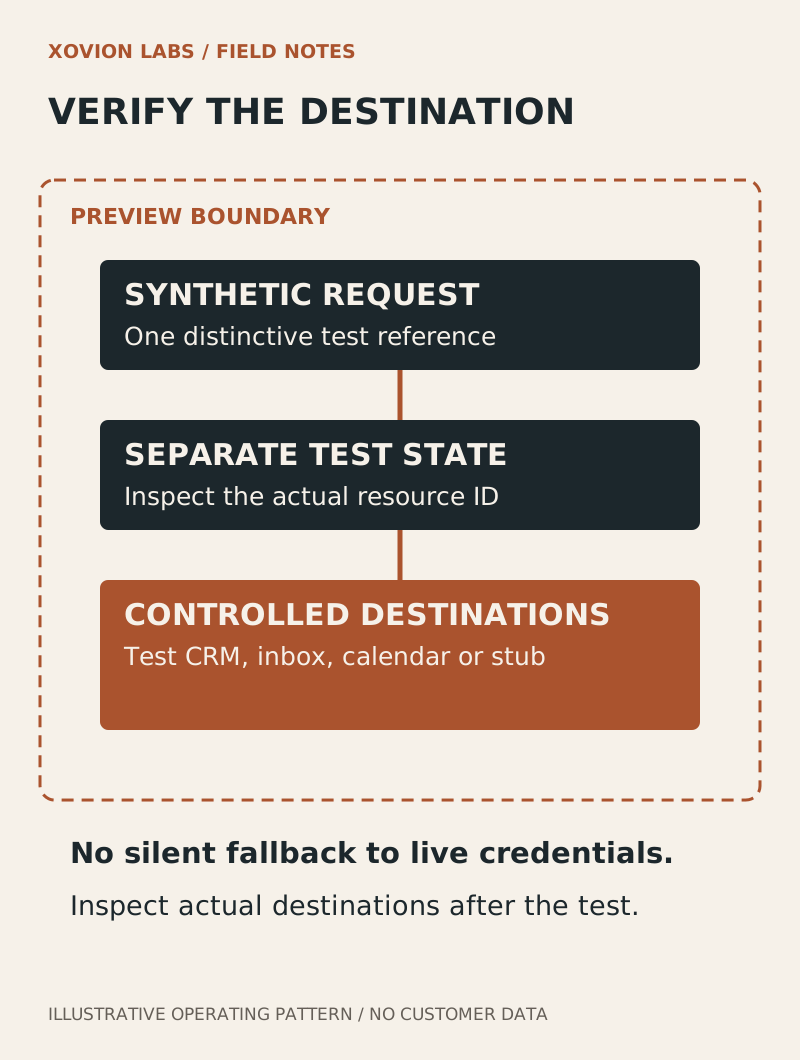
Prove the boundary with one marked request
Use a distinctive synthetic reference that you can search in every destination. Submit it once through the preview.
Confirm that the expected test record exists, then inspect the relevant live destinations through their authoritative records. The test should establish both what happened in the test environment and whether the reference appeared anywhere it should not.
An empty inbox alone is weak evidence. A provider could have queued a message, routed it elsewhere, or rejected it after accepting the request. Inspect the delivery or action history available for that provider.
Keep the test bounded. Do not use a real customer’s contact information to make a preview feel realistic.
Missing configuration should stop the test
A useful preview should fail visibly when its intended test connection is absent. Silently falling back to a live credential makes a configuration mistake look like a successful demonstration.
Ask the builder to show that failure case. Remove a required test setting in the isolated environment and verify that the action stops with a clear operator-facing explanation.
Then record the exact code version and configuration that passed. If either changes before release, decide which part of the evidence needs to be repeated. A screenshot of a preview from last week does not establish today’s connections.
Release is a different decision
Passing the preview boundary test proves a specific rehearsal stayed within scope. It does not prove the production configuration is correct or that a real submission will complete.
Use a separately approved production verification after release, proportionate to the action involved. Keep the distinction clear so an agent cannot treat a preview success as permission to operate live systems.
Continue with A Passing Test Is Not Production Proof. Before that release question, make the rehearsal safe enough to trust.
Source and scope
Cloudflare Worker Previews announcement, September 22, 2026. Platform isolation features are vendor-described. The destination map, configuration checks, and quote-form exercise are proposed practices; this article does not claim that a preview automatically isolates external providers.