Insights
Operations
More reported conversions can still mean the same number of customers
Google’s October measurement updates make one distinction more useful: an event your ad platform records and a customer outcome your business can verify.

A conversion chart rises after a tracking change. Everyone wants to call that a win.
It might be one. It might also mean the platform can now recognize activity that was already happening. Or the same inquiry might be arriving through more than one path.
Before spending against the improvement, connect the reported conversion to a unique business record and a defined outcome. Better measurement and better performance deserve separate lines in the report.
What changed
Google’s October 13 Demand Gen update says a Data Strength Uplift metric is launching in Google Ads. It also announces expansion of Data Manager to Display & Video 360 and Google Analytics, while describing enhanced conversions for those destinations as coming soon.
That wording matters: an announced launch, an expansion, and a future feature are different availability statements. Check your account before planning around any of them.
The operator question is independent of the rollout: what exactly became more observable, and what actually improved for the business?
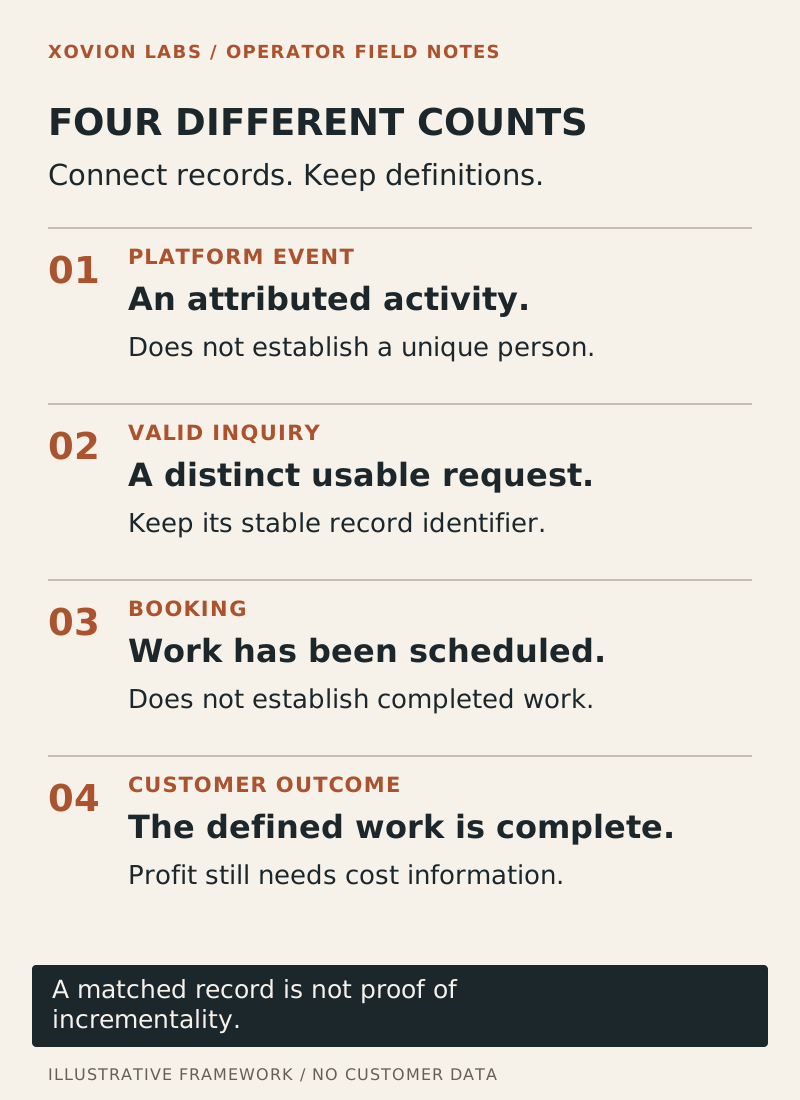
Keep four counts on the page
Imagine a hypothetical contractor measuring a request-a-quote journey. Someone clicks an ad, starts a form, submits a request, receives a callback, and eventually books a job.
Those steps describe different objects.
| Count | What it answers | What it does not establish |
|---|---|---|
| Platform conversion events | What did the platform record under its attribution rules? | Unique customers or incremental sales |
| Unique valid inquiries | How many distinct, usable requests reached the business? | Whether the ad caused each request |
| Confirmed bookings | How many requests became scheduled work? | Completed work or collected revenue |
| Completed customer outcomes | What work was completed under your definition? | Profit without cost information |
Put the definitions beside the numbers. A dashboard that calls every row “leads” forces the reader to guess.
Follow a single inquiry all the way through
Use an approved test record or a historical record your team is authorized to inspect. Find the form submission identifier, the saved inquiry, any platform event identifier, and the eventual booking record.
Do not join records on a person’s name alone. Names can repeat, spelling changes, and one person may make separate legitimate requests. Prefer the stable identifiers your systems actually preserve; document any fallback match.
Where a link is missing, keep the uncertainty visible. “All-source inquiries: known; ad-attributed inquiries: unresolved” is more useful than a confident blended cost per lead.
This is an implementation recommendation, not a claim that Google’s new features automatically supply the whole record chain.
Test measurement without changing the campaign
For a bounded first pass, choose one campaign and one complete reporting period. Keep the account timezone and attribution window explicit.
Write down the event definition before pulling the totals. Exclude known internal tests. Identify duplicate deliveries using stable event or inquiry identifiers. Then reconcile the platform count against valid inquiries and bookings.
Your output should show three things: the counts that agree, the records that cannot yet be matched, and the reason for each unresolved group.
A useful success test is whether another person can reproduce the valid-inquiry count from the same records. Do not require the platform total to equal your CRM total: their scopes and timing can differ.
Only after that baseline is clear should you evaluate whether a tracking improvement changed observed reporting, business outcomes, or both.
What this exercise cannot tell you
A matched inquiry is not proof that advertising created an incremental customer. Attribution assigns credit under a method; incrementality asks what would have happened without the advertising. That requires a different experiment.
Likewise, an increase in bookings does not establish profitability without job value, completion, and cost information.
Keep the first decision smaller: can you trust the count you are using to choose the next action? If not, repair the missing link before increasing spend on the strength of that number.
For the underlying record design, read From Messy Data to Trusted Data.
Source and scope
Google: October Demand Gen Drop, October 13, 2026. Availability language follows the announcement. The contractor example and reconciliation exercise are illustrative; no customer performance or promised uplift is asserted.