Insights
Operations
Trace the missing handoff before buying another dashboard
Follow one quote request from submission to callback. Find the first missing receipt before changing the wrong part of the workflow.

The form says submitted. The customer says nobody called. The CRM has no record. Each person looking at the problem has a different screen, and every screen seems to support a different explanation.
Before buying another dashboard, follow one request across the handoffs. The useful question is where the evidence stops.
A request needs a history
On October 2, Cloudflare introduced Traces in open beta. Its announcement describes a request timeline spanning supported platform operations, including routing, security decisions, Worker execution, and origin handling. It also describes passing trace context onward to other services.
That does not mean a tracing product can automatically explain every business outcome. A successful network request is different from a saved inquiry, an assigned owner, or a completed callback. Those later events need their own evidence.
The useful operating idea is continuity: stop investigating five unrelated screens and start investigating one piece of work.
Follow the quote request
Consider a hypothetical contractor whose website accepts quote requests. The intended path is simple: submission, saved inquiry, assigned owner, callback.
There are several ways to break that promise. The form might never reach the server. The server might accept it while the CRM is unavailable. The CRM might save it without assigning anyone. The owner might receive the task and never make the call.
Those failures need different fixes. Rebuilding the form will not repair an assignment rule. Reminding the salesperson will not recover a request that was never saved.
Start with a reference created when the request enters your system. Preserve that reference when handing work to the next component, or keep an explicit mapping to the receiving system’s identifier. Do not assume every vendor accepts the same tracing headers or exposes the same records.
For each handoff, ask for a small receipt:
| Stage | Evidence to preserve | Question it answers |
|---|---|---|
| Received | Request reference and observation time | Did this attempt reach us? |
| Saved | Destination record identifier | Does the inquiry exist? |
| Assigned | Owner and assignment time | Who is responsible now? |
| Followed up | Recorded action and outcome | Did the promised next step happen? |
Keep customer details out of the reference itself. A random identifier can connect the records without putting someone’s name or phone number into every log line.
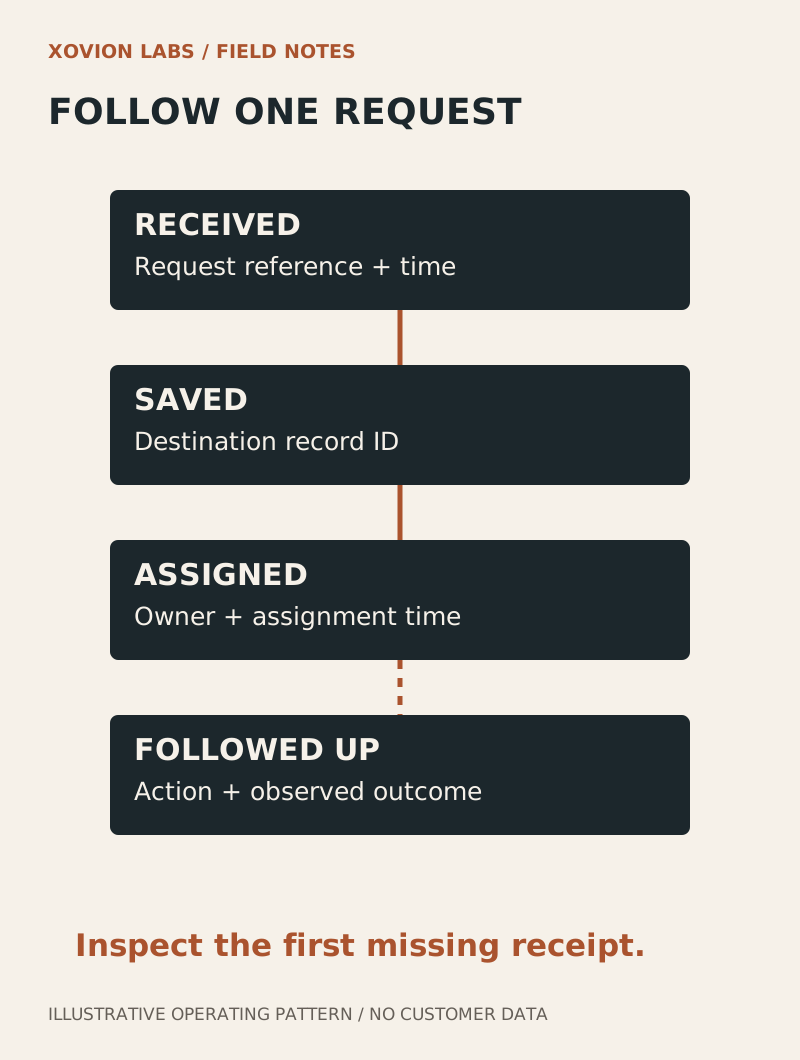
Investigate the first missing receipt
If the request was received but no destination record can be found, investigate that boundary first. Do not label the entire journey successful because the website returned a friendly message.
Equally, an absent trace is not proof that the customer never submitted anything. Sampling, retention, incomplete instrumentation, or an incorrect lookup can leave gaps. Mark the result unresolved until you have checked what the records actually cover.
This is why a daily reconciliation still earns its place. Compare the requests your intake system accepted with the destination records that should exist. A trace helps explain a particular journey; a reconciliation can identify journeys nobody has investigated yet.
Try a controlled failure
Use a test environment and a clearly labeled synthetic inquiry. Run a normal submission, then a second test with the CRM connection deliberately unavailable. Keep real notifications disabled.
The exercise passes when another operator can locate the first missing handoff, identify who owns the repair, and see whether the request is waiting for a retry or needs manual recovery. Also confirm that repeating the recovery does not create another inquiry.
You do not need to instrument the whole company to learn something useful. Start with the handoff people already argue about.
For the wider operating record, read Inside Xovion Books: Why We Built a Flight Recorder. Here the smaller goal is to explain one missing request without asking the customer to submit it again.
Source and scope
Cloudflare Traces announcement, October 2, 2026. Product capabilities are vendor-described and limited to supported operations. The contractor journey, record design, and failure exercise are illustrative recommendations, not measured Xovion results.