Insights
AI
A voice note and a document disagree. What should your AI save?
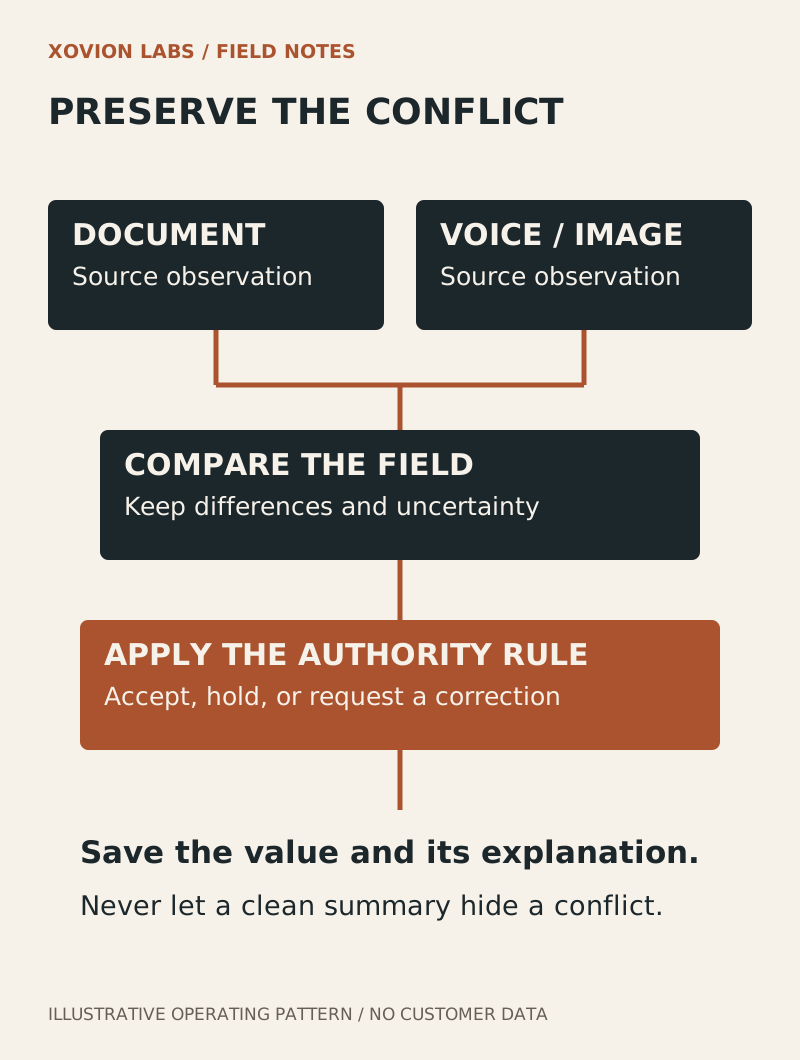
Multimodal input makes conflict handling more important. Preserve each source observation before accepting a change to the working record.

The document says one thing. The voice note says another. Your AI returns a clean, confident record with no sign that anything disagreed.
The output looks useful precisely because the uncertainty disappeared.
As models accept more kinds of input, the operating question gets sharper: when sources conflict, what is the system allowed to save?
More input does not establish authority
Cloudflare’s October 9 Clef-omni announcement describes a decision model that accepts audio and video alongside text and images. That makes it a useful prompt for thinking about workflows that combine a document, a photograph, and a spoken instruction.
The announcement establishes those input capabilities. It does not establish that the model will resolve your business’s conflicting records correctly, or that a spoken correction has authority to replace an approved document.
That rule belongs to the workflow.
Keep extraction separate from acceptance
Imagine a hypothetical equipment-service request. An uploaded job sheet identifies one location. A voice note mentions a different site. A photograph shows a label, but the last character is unclear.
There are at least three distinct jobs here:
- Extract what each source appears to say.
- Identify disagreements and missing information.
- Decide which values may enter the working record.
Combining those jobs in one instruction such as “read everything and update the request” makes the decision difficult to inspect. A fluent summary may quietly choose the most recent source, the most legible source, or the source mentioned last in the prompt.
Instead, ask for a field-level comparison before any live update.
| Field | Document | Voice or image | Proposed handling |
|---|---|---|---|
| Service site | One location | Different location | Hold for an authorized correction |
| Equipment identifier | Full identifier | Partly unreadable label | Preserve both observations; flag uncertainty |
| Requested work | Written task | Additional spoken request | Record as proposed scope until accepted |
These are illustrative conditions, not a real customer record. The important feature is that a disagreement remains visible after extraction.
Define who can change which field
Some differences are harmless formatting. Others change where a technician goes or what work the company promised.
Write the rule at that level. For example: normalize spacing in an equipment identifier, but never replace a service address solely because an unverified recording mentions another one. Route that conflict to the person authorized to approve the change.
Do not use “the latest input wins” as a universal rule. A newer message can be mistaken, incomplete, or unrelated to the same job. Keep timestamps and source references, then apply the actual authority rule.
If a correction is accepted, preserve the previous value, the new value, the supporting source, and who accepted it. The working record can become clean without destroying the explanation.
Build a small disagreement test
Prepare synthetic examples with deliberately chosen answers: matching sources, conflicting sites, an unreadable label, missing audio, and an irrelevant spoken aside. Decide the expected disposition for each before running the model.
Check the extraction and the decision separately. Did it read the field correctly? Did it preserve the conflict? Did it refrain from a live update when approval was required?
A useful first result is that every consequential conflict reaches the review queue with enough context to resolve it. Measure false alarms too: sending every formatting difference to a person can make the queue unusable.
Run the test against the actual input formats and model configuration you intend to use. A polished example from a launch post does not substitute for those cases.
Save the uncertainty before the summary
The next time you connect a voice note or photograph to an existing record, start with the disagreement rule. More capable input handling is valuable when it makes the record more trustworthy, not merely easier to fill.
For the foundation, read From Messy Data to Trusted Data. This exercise focuses on one decision: which source has earned the right to change one field?
Source and scope
Cloudflare’s Clef-omni announcement, October 9, 2026. Input capabilities are vendor-described. No extraction accuracy or production-readiness claim is made. The service-request examples and acceptance rules are illustrative recommendations.