The Signal
The Signal
Open weights do not tell you where your business data goes
An operator’s explainer on model ownership, local inference, and the connections that can still move information outside your environment.

The Signal · Explainer · September 29, 2026
“Open,” “local,” and “private” answer different questions. Treating them as synonyms can lead a business to buy hardware or approve a system for the wrong reason.
This is an explainer tied to the current availability of open models, not a claim of a new release this week. The Qwen team’s official repository dates Qwen3.8‑2.4T‑A95B to August 12 and Qwen3.8‑27B to August 14, 2026. It documents both hosted access and local deployment options and directs readers to the licenses distributed with the model weights.
Those dates matter. A newly circulated article about a model is not a new model launch. More importantly, downloadable weights give you a deployment option; they do not describe the complete system you will operate.
Draw the information path
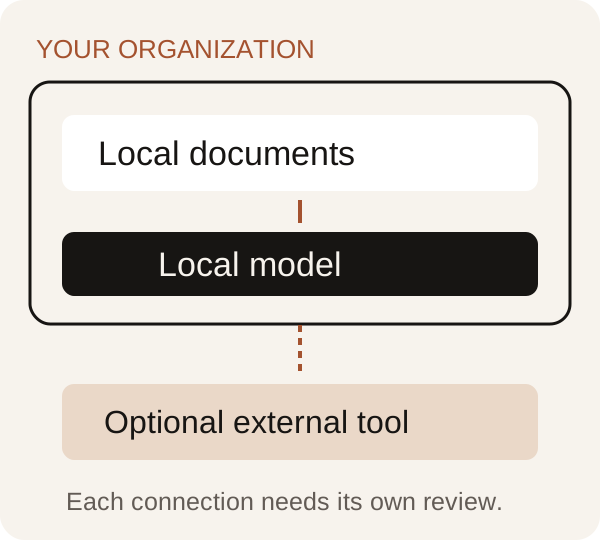
A local model may sit on a machine you control while its surrounding application calls a cloud search service, sends traces to an observability vendor, or retrieves documents from hosted storage. Whether those connections exist depends on your implementation.
Start by drawing the path of a representative request. Where does the source document originate? Where is it parsed? Where does inference run? What tools can the assistant call? Where do logs, backups, and output files end up?
For each connection, identify the actual destination and the person responsible for it. A statement that “the model runs locally” covers only one box in that picture.
A hypothetical document pilot
Imagine a manufacturer wants to search internal maintenance manuals without sending their contents to a hosted model. The first pilot could use a local document collection, local retrieval, and a local inference service, with external network access restricted.
The acceptance test should cover both answer quality and the intended data boundary. Can the assistant identify the correct manual revision? Does it cite the relevant section? Can the team inspect outbound connections and logging behavior? What happens if a document is missing or unreadable?
A fluent answer is insufficient if it came from the wrong revision. A network-isolated system is insufficient if its answers are unusable. The pilot has to satisfy both requirements.
This is a proposed architecture, not a product configuration guaranteed by Qwen or a system Xovion claims to have deployed.
Hardware is only part of the cost
Before purchasing equipment, run the intended workload on a representative configuration. Measure response time at expected concurrency, memory pressure, document-processing overhead, and the quality of the actual model format you plan to serve.
Do not infer a hardware requirement from an “active parameters” figure alone. Ask the deployment owner to account for the full weight representation, serving setup, context, and workload. Avoid importing performance claims from a different quantization, device, or prompt length.
Then add the operating responsibilities: installation, updates, access control, backups, monitoring, and recovery when the machine is unavailable. Assign an owner. If nobody will maintain it, local deployment may replace a subscription bill with an unowned system.
Choose the boundary for a reason
Local deployment can be attractive when control over data flow, offline operation, or customization is a real requirement. Hosted inference can be attractive when the team needs to start quickly or lacks the capacity to operate a serving environment.
Those are decision criteria, not universal verdicts. A hybrid design may be appropriate: a local process handles a bounded sensitive task while a hosted model handles public material. The routing rule must be explicit enough to test; “send only safe data” is not a usable specification by itself.
Review the license attached to the exact model artifact and version. A repository label, a family name, and the terms for a hosted service are not interchangeable evidence. This article makes no legal conclusion about a particular intended use.
What to do before buying a machine
Write down the requirement in plain language. For example: “These manuals must remain inside this environment, and operators must receive answers with page references within an acceptable wait.”
Ask a technical owner to demonstrate that requirement with representative documents and a visible data-flow map. Include a missing-document case and a recovery exercise. Compare the full operating burden with a hosted alternative that meets your actual constraints.
The takeaway is to choose control you can demonstrate. Open weights make more architectures possible. Your data boundary comes from the architecture you build and verify.
Related: Agent permissions: read, decide, act.
Primary source: Qwen3.8 official repository, checked September 29. Release dates are historical; architecture examples and purchasing guidance are editorial analysis, not fresh release news or measured Xovion results.
The Signal
Read next.
AI · Local AI
NVIDIA Just Released a 74-Billion-Parameter Model That Runs Like a Much Smaller One
NVIDIA's Nemotron Bolt 3.5 74B A9B is a large language model designed to run efficiently on hardware that would normally struggle with a model this size. Here is what operators need to understand about what that actually means.
Agents · Coding
Cloudflare gives coding agents their own repos. Who decides what ships?
Artifacts now lets teams fork agent work and wire previews to review. Isolation helps, but the acceptance decision needs evidence and an owner.